AI estimate as of October 14, 2025 · verify with a professional before acting
AI-Generated · Verify before acting
Everything on this page is generated by AI for informational purposes only. AI can make mistakes — the AI may misidentify items or misattribute them (artist, maker, brand, designer, origin, era). This is not an official valuation and should not be used for insurance, sale, tax, estate, legal, or lending purposes — or any decision requiring a certified appraisal. It is not an authoritative claim about any person, brand, or rights holder — do not share or rely on it as a factual statement about a third party. Always consult qualified professionals before making financial decisions.
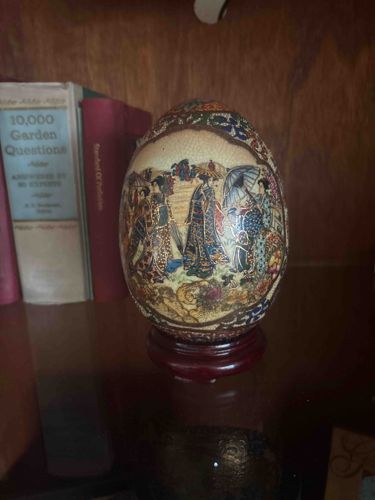
This item is a decorative egg-shaped ornament, likely crafted from porcelain or ceramic, adorned with intricate hand-painted designs in the Satsuma-style. The egg features a vibrant, multi-color palette dominated by gold accents, reds, blues, greens, and browns. The primary motif depicts a gathering of figures, presumably female, dressed in traditional Japanese kimonos, some holding parasols. Their faces are finely detailed, and their garments are richly patterned with floral and geometric designs, characteristic of Kutani or Satsuma ware. The background behind the figures appears to have a textured, crackled glaze effect, often seen in Satsuma pottery. Both the top and bottom portions of the egg, above and below the main figural scene, are embellished with complex, ornate borders combining abstract patterns, stylized foliage, and possibly auspicious symbols, again heavily accented with gold. The overall surface exhibits a high level of detail and craftsmanship, with delicate brushwork. The egg rests on a small, dark reddish-brown wooden stand, likely lacquered, which has a simple, rounded form designed to cradle the egg securely. Visible condition appears good, with no obvious chips, cracks, or significant paint loss; the gold embellishments seem largely intact. The presence of such intricate detail suggests it is either a vintage or antique piece, possibly dating from the late 19th or early to mid-20th century. The quality of the painting and the use of gold indicate a piece of decorative art intended for display, emphasizing aesthetic appeal and fine artistry.
AI Appraisal Report
Based on my visual examination of the provided image, this Satsuma-style porcelain decorative egg on a lacquered wooden stand presents as a well-preserved example of its type. The condition appears to be excellent, with no evident chips, cracks, or significant paint loss, and the gold embellishments, a key feature of Satsuma ware, seem largely intact. This good condition contributes positively to its market appeal.
Authenticity, based solely on imagery, points towards a late 19th to mid-20th-century decorative piece. The intricate hand-painted detail, particularly the finely rendered figures in traditional kimonos and the rich gold accents, is consistent with Satsuma or Kutani artistic traditions. The crackled glaze effect noted in the background further aligns with Satsuma characteristics. However, without a physical inspection, I cannot account for hidden repairs or restorations, nor definitively confirm the precise origin or age. In-person examination would allow for closer inspection of brushwork, weight, glaze quality, and any discernible maker's marks on the base of the egg, which are crucial for full authentication and dating. Provenance documentation, if available, would also significantly aid in verifying its history.
Demand for decorative Satsuma-style porcelain remains steady, particularly for pieces exhibiting high-quality artistry and good condition. While not exceedingly rare, a well-executed piece like this with detailed figural scenes and extensive goldwork commands more interest than simpler examples. Comparables for decorative eggs of this size and quality typically range from $300 to $800, depending on the artist, specific period, and market fluctuations. Given its apparent condition and decorative appeal, I would place its current appraisal value in the range of $350-700. Factors that would further impact value positively include a verified artist's signature, a known provenance, or an earlier production date within the described period.