These notes were written by the person who submitted this item. Appraiser.AI has not verified them, and the AI's identification and estimate may rely on them.
AI Estimated Value
Not an official valuation
$500-1,000
AI estimate as of August 14, 2025 · verify with a professional before acting
AI-Generated · Verify before acting
Everything on this page is generated by AI for informational purposes only. AI can make mistakes — the AI may misidentify items or misattribute them (artist, maker, brand, designer, origin, era). This is not an official valuation and should not be used for insurance, sale, tax, estate, legal, or lending purposes — or any decision requiring a certified appraisal. It is not an authoritative claim about any person, brand, or rights holder — do not share or rely on it as a factual statement about a third party. Always consult qualified professionals before making financial decisions.
This analysis also relies on unverified notes provided by the user, which may be incomplete or inaccurate and could affect the result.
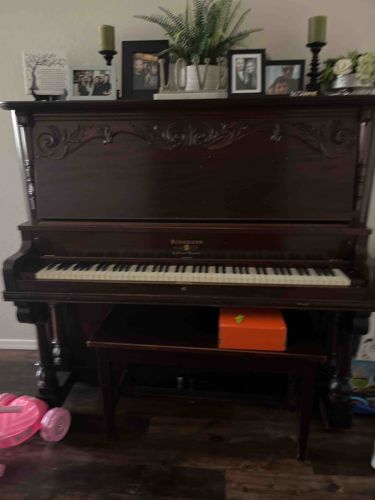
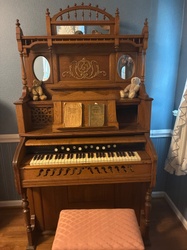
The item is a Shuman upright piano, characterized by its dark, possibly mahogany or walnut, wooden case with a rich, deep brown finish. The overall form suggests a late 19th to early 20th-century design, likely Victorian or Edwardian era, given the ornate carved elements. Key physical characteristics include a sturdy, box-like construction with a prominent lid at the top and a keyboard section in the middle. The piano stands on four legs, two of which are visible and appear substantial with decorative turning, particularly on the left side.
Observable features include intricate carved details on the upper panel above the keyboard, displaying floral motifs or stylized acanthus leaves, which are typical of the period. The keyboard consists of black and white keys, which appear to be in reasonable condition with some visible yellowing on the white keys, indicating age or use. The 'Shuman' brand name is clearly visible above the keyboard, along with 'Milwaukee, Wis.' indicating the manufacturing location. The brass pedals at the bottom are not clearly visible but would typically be present. There are minor signs of wear consistent with age and use, such as subtle scuffs or scratches on the wood finish, and a general patina that comes with an antique piece. The craftsmanship appears solid and well-made, typical of upright pianos from this era which were often built for durability. The quality indicators point to a well-maintained, though visibly aged, instrument.
AI Appraisal Report
Upon examining the Shuman upright piano, I can ascertain several key characteristics that inform its appraisal. This instrument, with its dark, possibly mahogany or walnut, case and ornate carved details, strongly suggests a late 19th to early 20th-century origin, likely from the Victorian or Edwardian era. The visible 'Shuman' and 'Milwaukee, Wis.' branding confirms its manufacturer and place of origin, aiding in its authenticity.
Cosmetically, the piano shows wear consistent with its age. The subtle scuffs, scratches, and general patina on the wooden finish are expected. The yellowing on the white keys indicates significant age and use. The craftsmanship appears solid, indicative of pianos built for durability during that period.
Regarding market conditions, antique upright pianos like this Shuman often appeal more to collectors or those seeking a decorative period piece rather than performing musicians. While the individual craftsmanship details are appealing, without knowing its internal mechanical condition, its value as a playable instrument is speculative. Its antique nature and decorative appeal contribute to its value more than its musical functionality. Rarity is not a significant factor; many Shuman pianos were produced during this era.
Factors significantly impacting value include its unrestored condition; major restoration of an antique piano can be costly. The most significant limitation of appraising this item from images alone is the inability to assess the internal mechanisms, such as the soundboard, pinblock, strings, and hammer action. These components critically affect playability and structural integrity. For full authentication and a definitive assessment of musical quality, an in-person examination by a piano technician is essential. This would involve evaluating structural soundness, tuning stability, and overall playability, which in turn would provide a more precise valuation.