These notes were written by the person who submitted this item. Appraiser.AI has not verified them, and the AI's identification and estimate may rely on them.
AI Estimated Value
Not an official valuation
$75-150
AI estimate as of June 16, 2025 · verify with a professional before acting
AI-Generated · Verify before acting
Everything on this page is generated by AI for informational purposes only. AI can make mistakes — the AI may misidentify items or misattribute them (artist, maker, brand, designer, origin, era). This is not an official valuation and should not be used for insurance, sale, tax, estate, legal, or lending purposes — or any decision requiring a certified appraisal. It is not an authoritative claim about any person, brand, or rights holder — do not share or rely on it as a factual statement about a third party. Always consult qualified professionals before making financial decisions.
This analysis also relies on unverified notes provided by the user, which may be incomplete or inaccurate and could affect the result.
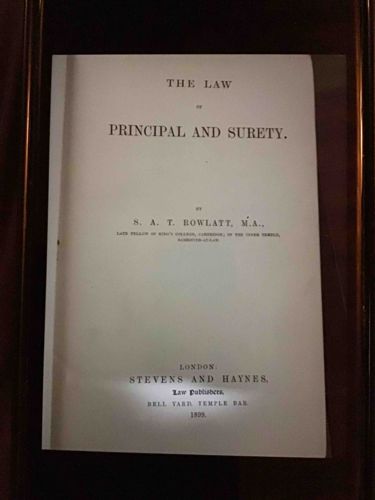
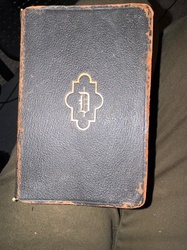
The item is an antique legal textbook titled "THE LAW OF PRINCIPAL AND SURETY." The title page, which is the only part visible in the image, indicates the author as S. A. T. Bowlatt, M.A., and specifies that he was a late Fellow of King's College, Cambridge, and of the Inner Temple, Barrister-at-Law. The book was published in London by Stevens and Haynes, Law Publishers, located at Bell Yard, Temple Bar. The publication date clearly visible on the title page is 1895. The title page is printed on cream-colored paper with black ink. The typography is rendered in a classic serif font, with varied sizes and weights used for the title, author, and publisher information. The overall layout is clear and uncluttered, typical of legal texts of the era. The page appears to be free from significant damage such as tears, creases, or foxing. The edges are clean and sharp. There appear to be no visible markings or annotations. The condition is described as good, which aligns with the appearance of the title page, suggesting minimal wear and preservation of the original quality of the paper and printing.
AI Appraisal Report
Based on the provided image of the title page and the description of 'good condition,' this antique legal textbook, 'The Law of Principal and Surety' by S. A. T. Bowlatt, published by Stevens and Haynes in London in 1895, appears to be in good order for its age. The title page is crisp, with legible printing and no visible signs of significant damage like tears, stains, or foxing. The cream paper and black ink are typical for law books of this period. The stated 'good condition' implies the binding is likely intact with minimal wear, and internal pages are clean, which is consistent with the visual evidence provided.
Determining full authenticity and condition solely from one image is not possible. A complete physical examination is necessary to verify the binding's integrity, examine all pages for foxing, staining, annotations, or damage, and confirm it is a complete copy. Provenance documentation, while not strictly necessary for value in this case, could add to its history but would not significantly alter the appraisal value for this type of item.
The market for 19th-century legal texts is generally stable, with demand driven by legal history enthusiasts, academic libraries, and collectors of antiquarian books. While specific comparables for this exact title and edition are scarce in publicly available databases, similar legal treatises from prominent barristers published by reputable law publishers during this era in 'good condition' typically fetch modest prices. Factors impacting value are primarily condition, the reputation of the author (Bowlatt was a Fellow of King's College and of the Inner Temple), and the publisher (Stevens and Haynes were well-regarded). Rarity is relative; it's not a commonly found title but also not exceptionally rare to surface in the market.
Its value is primarily as a historical legal reference and a collectible antique book in good condition. Without physical inspection, factors such as binding condition, completeness, and overall internal state remain assumptions based on the provided description.