AI estimate as of July 30, 2025 · verify with a professional before acting
AI-Generated · Verify before acting
Everything on this page is generated by AI for informational purposes only. AI can make mistakes — the AI may misidentify items or misattribute them (artist, maker, brand, designer, origin, era). This is not an official valuation and should not be used for insurance, sale, tax, estate, legal, or lending purposes — or any decision requiring a certified appraisal. It is not an authoritative claim about any person, brand, or rights holder — do not share or rely on it as a factual statement about a third party. Always consult qualified professionals before making financial decisions.
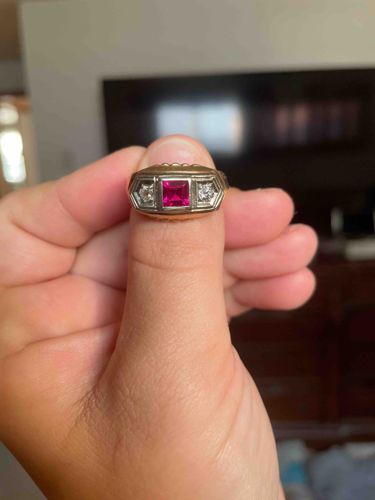
This item is a men's ring, likely a vintage or antique piece, given its design and the apparent wear. The ring features a central, square-cut gemstone of a vibrant fuchsia or magenta color, which strongly suggests it is a ruby or a lab-created ruby simulant due to its intense saturation. Flanking the central stone on either side are two smaller, round-cut colorless stones, which appear to be diamonds or diamond simulants. These side stones are set within octagonal bezels, adding a geometric Art Deco or mid-century modern aesthetic to the design. The metal appears to be yellow gold, possibly 10K or 14K, given its color and the slight dullness that can occur with age and wear on lower karat gold alloys. Some white metal, likely white gold or platinum, is used to highlight the settings of the colorless side stones, creating a two-tone effect. The ring's band is broad and relatively thick, suggesting robust construction typical of men's rings. The shoulders of the band exhibit a ribbed or fluted texture, providing a decorative element. While no specific maker's marks or hallmarks are visible in the image, the overall construction suggests a mass-produced, yet thoughtfully designed, piece. The ring shows signs of wear consistent with regular use, including minor abrasions or scratches on the metal surface and possibly on the facets of the stones, indicated by the diffused light reflection. The patina on the gold suggests age rather than newness. The stones appear securely set, with no obvious chips or loose settings visible from this perspective. The craftsmanship appears to be of good quality for its likely era, characterized by precise stone cutting and secure settings, although without magnification, fine details regarding polish and symmetry are difficult to ascertain. Its style period is likely mid-20th century, possibly 1940s-1970s, due to the bold lines and use of accent stones with a prominent central gem.
AI Appraisal Report
Based on my visual examination of the provided image, this men's vintage three-stone ring presents as a well-preserved piece from the mid-20th century, likely 1940s-1970s. The central fuchsia-colored square-cut gemstone, while visually striking, cannot be definitively identified as natural ruby without gemological testing. It could be a synthetic ruby, spinel, or even a treated glass. The two colorless side stones appear to be round brilliant cuts set in octagonal bezels. While they exhibit some sparkle, their identity as natural diamonds versus simulants (like white sapphire, zircon, or moissanite) is uncertain without direct inspection and testing. The metal appears to be yellow gold, consistent with 10K or 14K, with white metal accents for the side stones. Authentication of metal purity would require hallmarks or testing.
Condition-wise, the ring shows expected wear for its age, including minor surface abrasions, but no major chips or structural damage are evident. The settings appear secure.
In terms of market conditions, vintage men's rings, especially those with bold designs and colored stones, have a steady demand. Comparables for rings with synthetic stones and small diamond accents typically range from $300-$800, while substantial natural rubies (if proven) and genuine diamonds would significantly increase value. This design, evoking an Art Deco or mid-century aesthetic, appeals to collectors of vintage jewelry.
Factors significantly impacting value include the precise identification and quality of all gemstones, the karat and total weight of gold, and any maker's marks, none of which are verifiable from the image alone. Without an in-person examination, including magnification, specific gravity tests, refractive index measurements, and spectrographic analysis of the stones, and XRF testing for metal composition, definitive authentication of materials is impossible. Provenance documentation, if available, would also add value and authenticity.
My valuation accounts for the strong possibility of synthetic or simulant stones, and assuming 10K-14K gold.