AI estimate as of July 25, 2025 · verify with a professional before acting
AI-Generated · Verify before acting
Everything on this page is generated by AI for informational purposes only. AI can make mistakes — the AI may misidentify items or misattribute them (artist, maker, brand, designer, origin, era). This is not an official valuation and should not be used for insurance, sale, tax, estate, legal, or lending purposes — or any decision requiring a certified appraisal. It is not an authoritative claim about any person, brand, or rights holder — do not share or rely on it as a factual statement about a third party. Always consult qualified professionals before making financial decisions.
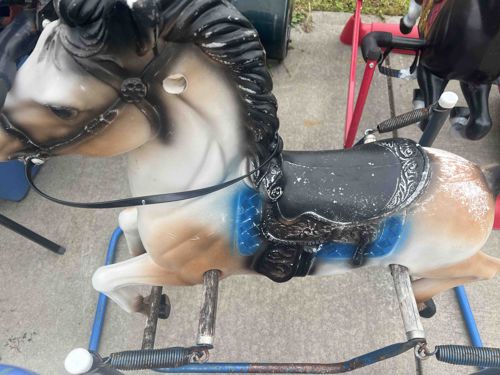
This is a vintage spring-loaded bouncing horse, designed as a ride-on toy for children. The horse itself appears to be constructed from molded plastic, possibly polyethylene or a similar durable polymer, featuring a realistic (though stylized) horse shape. Its coloration includes a base of light tan or cream, with darker airbrushed accents of black and grey to simulate a horse's mane, tail, and facial features. The mane is long and black, textured to mimic individual strands. The horse wears an integrated black bridle with a skull-like decorative element on the browband. The saddle is also molded plastic, black, with silver or white painted filigree-like scrolling ornamentation on the skirt, simulating a Western saddle. There are noticeable scuffs and marks on the saddle, indicating significant use. A prominent feature is the bright blue painted detail on the horse's underside, possibly intended to highlight some part of the 'blanket' under the saddle, or as a repair/customization. The horse is mounted on a blue metal frame, which is equipped with four heavy-duty springs connecting the horse's legs to the base frame. These springs facilitate the characteristic bouncing motion. The metal frame shows signs of wear, including scratched paint and some surface rust, particularly on the attachment points for the springs and the horizontal bar that connects the front and rear spring assemblies. One of the spring attachment points on the horse's body appears to be a metal rod inserted into the plastic leg. There is a visible hole in the horse's head, likely for a handlebar which is now missing. The overall condition suggests significant outdoor use and age, exhibiting dirt, scuffs, and faded areas consistent with typical wear for a well-loved children's toy of this type. The craftsmanship points to mass production, common for toys from the mid-to-late 20th century. While no specific manufacturer's marks are visible, the design is characteristic of popular bouncy horse toys from manufacturers like Wonder Horse or similar brands from the 1960s-1980s.
AI Appraisal Report
This vintage spring-bouncing horse, based on visual examination, appears to be an authentic example of a mass-produced children's ride-on toy from the mid-to-late 20th century, likely dating from the 1960s-1980s. Its construction from molded plastic and a metal frame is consistent with toys from that era. The 'skull-like' bridle element and Western saddle style suggest a generic, popular design. The blue paint on the horse's underside seems to be a later addition or customization rather than original factory detail. The overall condition is fair to poor, showing significant signs of wear including scuffs, scratches, faded areas, and surface rust on the metal frame. The missing handlebar and visible hole in the head further detract from its completeness and aesthetic appeal. These elements indicate it was a heavily used and well-loved toy, possibly stored outdoors at times.
Market conditions for these vintage bouncing horses vary widely, largely dependent on manufacturer, completeness, and condition. While examples from well-known brands like Wonder Horse in excellent, complete condition can fetch higher prices, generic or heavily worn examples typically have limited demand. This specific piece, given its condition issues and apparent lack of distinct manufacturer markings (which cannot be confirmed from images alone), falls into the lower end of the collectible spectrum. Its rarity is low; these were mass-produced. The missing handlebar, heavy wear, and surface rust negatively impact its value, as does the non-original blue paint on the horse's body. These factors significantly reduce its appeal to serious collectors, who prioritize originality and preservation.
Limitations: My assessment of authenticity is based purely on visual cues from the image. To confirm authenticity fully, an in-person examination would be critical to inspect material integrity, manufacturing marks (often located in less visible areas), and to confirm if any repairs or modifications beyond the blue paint have been made. Provenance documentation (e.g., original sales receipts, family history) could also provide valuable context regarding its age and origin. Scientific testing for plastic composition or paint analysis would only be necessary if there were specific concerns about its period or originality beyond what visual inspection provides, which is not suggested here.