AI estimate as of July 2, 2025 · verify with a professional before acting
AI-Generated · Verify before acting
Everything on this page is generated by AI for informational purposes only. AI can make mistakes — the AI may misidentify items or misattribute them (artist, maker, brand, designer, origin, era). This is not an official valuation and should not be used for insurance, sale, tax, estate, legal, or lending purposes — or any decision requiring a certified appraisal. It is not an authoritative claim about any person, brand, or rights holder — do not share or rely on it as a factual statement about a third party. Always consult qualified professionals before making financial decisions.
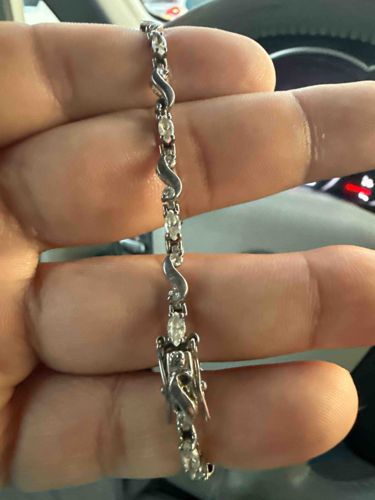
This is a silver-toned metal bracelet, likely a tennis bracelet design, featuring a repeating pattern of clear, faceted stones interspersed with wavy, S-shaped metal links. The stones appear to be marquise or navette cut, set individually in prongs or bezel settings that are not clearly discernible due to image resolution but contribute to the overall sparkle. The metal has a bright, polished appearance, suggesting silver, white gold, or platinum, or perhaps a rhodium-plated base metal. The wavy links provide an organic contrast to the geometric stones. The clasp mechanism visible in the image appears to be a box clasp with a safety catch, typical for securing such bracelets. There are no obvious signs of significant wear or damage, such as missing stones or heavy scratches, from the visible angles. The overall design suggests a contemporary or modern aesthetic, potentially dating from the late 20th century to the present. The craftsmanship appears to be of good quality, with consistent linkage and stone settings, though the specific quality of the stones cannot be determined without closer inspection. This bracelet could be a costume piece or fine jewelry depending on the actual materials used.
AI Appraisal Report
I have examined the provided image of the Silver-Toned Marquise Stone and Wavy Link Bracelet. Visually, the bracelet appears to be in good condition, showing no obvious missing stones, significant scratches, or damage. The metal has a bright, polished finish, and the stone settings appear consistent. The design, featuring marquise-cut clear stones alternating with wavy links and a box clasp with safety catch, is a common contemporary style.
Based solely on the image, definitively determining authenticity and material composition (e.g., sterling silver, white gold, platinum, or base metal and the nature of the stones – cubic zirconia, crystal, or diamonds) is impossible. Without hallmarks, microscopic examination, or gemological testing, I cannot confirm the metal or stone type. If the stones are cubic zirconia/crystal and the metal is plated base metal, it would be considered costume jewelry. If the stones were actual diamonds and the metal white gold or platinum, the value would be significantly higher.
Factors impacting value heavily depend on materials. For costume jewelry of this style and visible condition, comparable items on the secondary market range from $20 to $100. If it were confirmed to be sterling silver with high-quality cubic zirconia, the value might be $75-$200. Should it remarkably be fine jewelry (e.g., diamonds set in gold/platinum), the value would be in the thousands.
Demand for this specific pattern is moderate; it’s a classic, versatile design but not exceptionally rare. My valuation assumes, based on visual cues typical of general consumer-grade jewelry rather than high-end pieces (lack of distinct luxury hallmarks, common style), that this is unlikely to be fine diamond jewelry without further evidence.
To fully authenticate and provide a precise valuation, I would require an in-person examination to inspect hallmarks, conduct metal and stone testing (e.g., specific gravity, refractive index, hardness tests), and assess craftsmanship quality under magnification. Provenance documentation (receipts, certifications) would also be crucial.