These notes were written by the person who submitted this item. Appraiser.AI has not verified them, and the AI's identification and estimate may rely on them.
AI Estimated Value
Not an official valuation
$75-125
AI estimate as of July 2, 2025 · verify with a professional before acting
AI-Generated · Verify before acting
Everything on this page is generated by AI for informational purposes only. AI can make mistakes — the AI may misidentify items or misattribute them (artist, maker, brand, designer, origin, era). This is not an official valuation and should not be used for insurance, sale, tax, estate, legal, or lending purposes — or any decision requiring a certified appraisal. It is not an authoritative claim about any person, brand, or rights holder — do not share or rely on it as a factual statement about a third party. Always consult qualified professionals before making financial decisions.
This analysis also relies on unverified notes provided by the user, which may be incomplete or inaccurate and could affect the result.
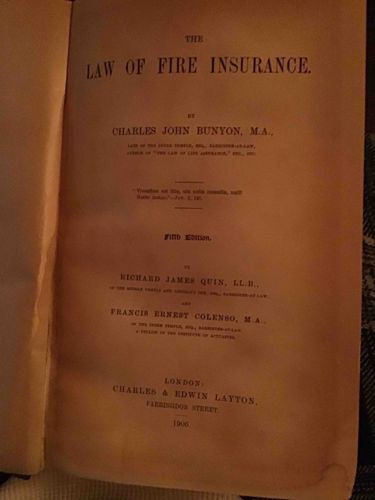
This item is an antique legal textbook titled "The Law of Fire Insurance," authored by Charles John Bunyon, M.A., and revised by Richard James Quin, LL.B., and Francis Ernest Colenso, M.A. The book is explicitly stated as the "Fifth Edition" on the title page. Published in 1906 by Charles & Edwin Layton, located on Faringdon Street in London, this publication is a significant historical document for legal and insurance studies. The paper shows an aged, warm cream or light brown tone, consistent with its age. The typography on the title page appears clear and well-preserved, employing a mix of serif fonts for headings and body text, characteristic of early 20th-century printing. The physical condition is described as 'good,' which aligns with the visible lack of major tears, creases, or extensive staining on the open page. There are some faint, subtle discoloration marks visible in the bottom right corner of the page, possibly from moisture or handling over time, but these do not seem to impede readability or compromise the overall integrity of the page. The binding, though not fully visible, appears to hold the pages securely, indicated by the smooth curve of the spine on the left. The overall craftsmanship suggests a professionally produced volume, with crisp printing and presumably durable paper for its time, designed for serious study and reference.
AI Appraisal Report
Based on my visual examination of the provided image and the owner's description, this 1906 Fifth Edition of "The Law of Fire Insurance" by Bunyon appears to be in good condition. The paper shows appropriate aging with a warm cream tone, and the typography is clear, consistent with early 20th-century printing. The slight discoloration in the bottom right corner and the smooth spine curve suggest general wear but no major damage.
Authenticity: While the image strongly supports the book's stated identity and age, a full authenticity verification would require in-person examination. I would need to inspect the binding, paper quality, watermarks (if any), and printing methods more closely to confirm its originality and rule out any later reproductions or significant repairs not visible in the image. Provenance documentation, such as receipts or historical ownership records, would further strengthen its authentication.
Market Conditions & Comparables: Legal texts of this specific nature and era generally have a niche market. Comparables for similar antique legal treatises from the early 20th century in 'good' condition typically range from $50 to $150. Rare or first editions of very influential works can command higher prices, but a 'Fifth Edition' suggests a degree of commonality in its time.
Demand & Rarity: The demand for this specific legal text is likely low, appealing primarily to legal historians, insurance scholars, or specialized collectors of antique law books. As a fifth edition, it's not exceedingly rare. Its value is more tied to its historical significance as a reference work than to a unique collector's item.
Factors Impacting Value: The 'good' condition is a positive factor. However, its status as a fifth edition and the specialized, low-demand subject matter significantly limit its market value. Without further verification of its unique historical significance beyond being a legal text, its value is modest.