AI Appraisal Estimate

AI-generated estimates · not official valuations

From the user

What was submitted

Photo and notes provided by the user — not generated by AI

Submitted item photo
Submitted photo · May 27, 2026

User's notes

No additional notes provided.

AI analysis below

AI appraisal

AI analysis & estimate

AI-Generated · Verify before acting

Everything below is generated by AI for informational purposes only. AI can make mistakes — the AI may misidentify items or misattribute them (artist, maker, brand, designer, origin, era). This is not an official valuation and should not be used for insurance, sale, tax, estate, legal, or lending purposes — or any decision requiring a certified appraisal. It is not an authoritative claim about any person, brand, or rights holder — do not share or rely on it as a factual statement about a third party. Always consult qualified professionals before making financial decisions.

Read the full disclaimer

AI Identification

·Not independently authenticated·Verify before acting

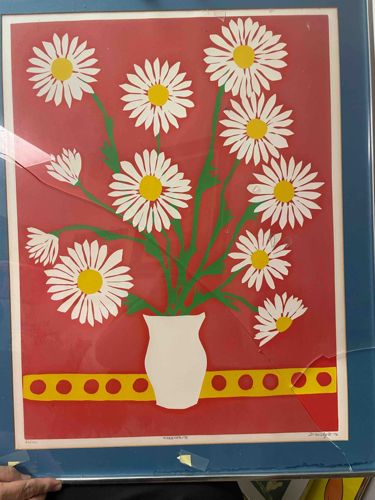
Screenprint of Daisies in a Vase

Art Print

AI Estimated Value

·Not an official valuation·Verify before acting

$100-200

As of May 27, 2026

AI Item Analysis

·AI can make mistakes·Verify before acting
This is a framed screenprint depicting a vibrant still life of daisies in a white vase against a red background. The artwork features a stylized arrangement of numerous white daisies with bright yellow centers, connected by vivid green stems and leaves. The daisies are rendered with simple, bold shapes, typical of a mid-century modern aesthetic. The white vase, positioned centrally at the bottom, has a slightly flared rim and base. It rests on a yellow band embellished with evenly spaced red dots, which creates a visual division in the red background. The overall color palette is restricted to red, white, yellow, and green, contributing to its graphic and bold appearance. The print appears to be housed under glass within a blue frame, which shows some wear and possibly adhesive residue from tape near the bottom. The glass itself has visible cracks and reflections, particularly in the lower left and right sections, indicating damage to the protective layer. The nature of the print, likely a screenprint or serigraph, suggests a mechanically produced artwork with flat, unmodulated color areas and sharp edges. The style evokes a feeling of cheerful simplicity and decorative appeal, characteristic of popular prints from the latter half of the 20th century. There are visible inscriptions at the bottom, which are difficult to decipher fully but likely include the artist's signature, title, and possibly a print number or edition.

AI Appraisal Report

·AI can make mistakes·Verify before acting
Based on my visual examination of the provided image, this framed screenprint depicts a stylized still life of daisies. The print exhibits a mid-century modern aesthetic with its bold shapes and limited color palette of red, white, yellow, and green. While the print itself appears to be a serigraph or screenprint, suggesting a mechanically produced artwork, several factors significantly impact its value. Condition is a major concern. The frame is worn, and the protective glass is visibly cracked in multiple places, indicating damage and a need for repair or replacement. There also appears to be adhesive residue on the frame. These condition issues detract significantly from the aesthetic appeal and market value of the piece. Authenticity is difficult to determine definitively from images alone. While there are inscriptions at the bottom, their legibility is poor, making it impossible to identify an artist, title, or edition number. Without a verifiable signature or edition information, attributing the work to a recognized artist is impossible. Market conditions for decorative screenprints of this type, especially those with condition issues and unconfirmed authorship, are generally modest. Comparables would typically fall into the category of decorative wall art rather than fine art prints by established artists. Demand for such pieces is present but not high, primarily for decorative purposes. Rarity would be difficult to assess without edition information. To fully authenticate this piece and provide a more precise valuation, an in-person examination would be critical to assess the print's condition directly, inspect the frame and any damage, and attempt to decipher the inscriptions. Provenance documentation, such as purchase receipts or certificates of authenticity, would be highly valuable. Scientific testing of the inks and paper could also provide insights into its age and production methods if attribution to a specific artist or workshop were being pursued.

Get your items appraised

Instant estimates of your treasures with AI-powered appraisals

Browse More Appraisals