AI estimate as of August 10, 2025 · verify with a professional before acting
AI-Generated · Verify before acting
Everything on this page is generated by AI for informational purposes only. AI can make mistakes — the AI may misidentify items or misattribute them (artist, maker, brand, designer, origin, era). This is not an official valuation and should not be used for insurance, sale, tax, estate, legal, or lending purposes — or any decision requiring a certified appraisal. It is not an authoritative claim about any person, brand, or rights holder — do not share or rely on it as a factual statement about a third party. Always consult qualified professionals before making financial decisions.
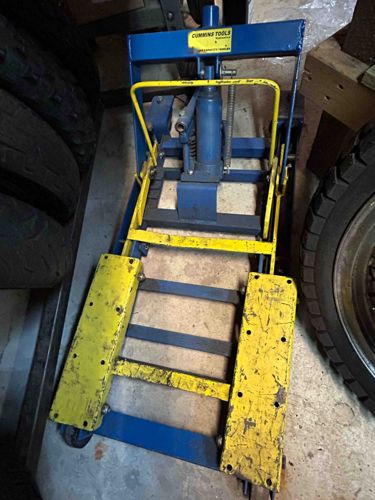
The item is a two-tone blue and yellow hydraulic engine hoist or shop crane, designed for lifting heavy objects like vehicle engines. Its primary structure is robust steel, painted in a deep blue, forming the vertical support and the base frame. Attached to the top horizontal blue bar is a yellow label, partially visible, which appears to bear the brand name 'CUMMINS TOOLS'. The lifting mechanism is a large blue hydraulic ram, centrally mounted, connected to a spring-loaded return mechanism. A yellow U-shaped handle or frame is prominently featured, likely for maneuvering or supporting the hydraulic cylinder. The base of the hoist features two broad, flat yellow sections, which serve as the lifting arms or stabilizers, with visible bolt holes suggesting adjustability or attachment points. The entire unit is on small, recessed wheels at the very bottom of the yellow sections, indicating it is designed to be mobile.
Condition-wise, the item shows significant signs of use and wear consistent with a piece of workshop equipment. The paintwork, particularly the yellow, is heavily abraded and chipped in multiple areas, revealing the bare metal beneath. There are numerous scratches, scuffs, and some areas of surface rust, especially on the yellow components, indicating its age and constant use in a demanding environment. The blue painted surfaces also show wear, though perhaps slightly less severely than the yellow. All visible bolts, welds, and structural components appear intact, suggesting functional integrity despite the cosmetic wear. The hydraulic cylinder appears to be in working order, though its exact operational smoothness cannot be determined from the image. The general craftsmanship appears to be industrial-grade, built for durability and strength rather than aesthetic appeal. This type of hoist would typically be found in an automotive repair shop, private garage, or similar industrial setting. Based on the visible wear and the 'CUMMINS TOOLS' branding, it appears to be a practical, utilitarian piece of equipment likely from the last few decades, designed for heavy-duty lifting tasks.
AI Appraisal Report
Based on my visual examination of the Cummins Tools Hydraulic Engine Hoist, it presents as a robust, utilitarian piece of workshop equipment. The two-tone blue and yellow paint, while severely abraded and chipped, particularly on the yellow components, reveals consistent heavy use. Visible bare metal and surface rust are indicative of its age and demanding environment. The overall structural integrity appears sound, with all visible bolts and welds intact, suggesting it remains functionally capable despite cosmetic wear. The 'CUMMINS TOOLS' branding, while partially obscured, reinforces its identity as a commercially produced, industrial-grade item.
From the image alone, I cannot definitively confirm the operational smoothness of the hydraulic cylinder or the presence of any internal leaks; a physical inspection and function test would be required for this. Similarly, the exact weight capacity, critical for assessing its utility, is not discernible without a visible data plate or manufacturer specifications. Authenticity, in terms of it being a genuine Cummins Tools hoist, is highly probable given the visible branding and typical aesthetics of their products, but without provenance documentation (e.g., original receipts, manuals) or a physical inspection for serial numbers, 100% verification is impossible through images alone. In-person examination would also allow for assessment of wheel condition, ram seal integrity, and overall frame rigidity.
Regarding market conditions, similar used engine hoists, particularly from established brands like Cummins Tools, are in consistent demand within the automotive repair, garage, and DIY mechanic sectors. They are not rare items; a quick search on online marketplaces (e.g., eBay, Facebook Marketplace, specialized tool auction sites) shows a steady supply. Comparables in similar condition typically range significantly based on brand, capacity, and actual working order. Given the visible wear and the need for functional verification, it would fall on the lower end of the spectrum for a used hoist.
Factors significantly impacting its value include its age, cosmetic condition (which deters some buyers), and the unknown status of the hydraulic system. If the hydraulic system is fully functional without leaks, its value increases. If it requires repair or replacement of seals, the value would decrease considerably. Its mobility, albeit on small wheels, adds to its practical value. The industrial-grade craftsmanship suggests durability, a positive factor.
To fully authenticate and precisely value this hoist, I would need to:
1. Physically inspect and test the hydraulic lift mechanism for smooth operation, leaks, and full extension/retraction.
2. Verify the weight capacity (e.g., 1-ton, 2-ton) from a data plate or manufacturer's specifications.
3. Examine all structural welds and pivot points for signs of fatigue or damage not visible in the image.
4. Check the condition of the wheels and casters for smooth rolling.
5. Seek any available provenance documentation, though for utilitarian tools, this is rarely available.
Without these additional checks, my appraisal is based purely on the visual cues of a well-used but structurally sound piece of equipment.