AI estimate as of August 18, 2025 · verify with a professional before acting
AI-Generated · Verify before acting
Everything on this page is generated by AI for informational purposes only. AI can make mistakes — the AI may misidentify items or misattribute them (artist, maker, brand, designer, origin, era). This is not an official valuation and should not be used for insurance, sale, tax, estate, legal, or lending purposes — or any decision requiring a certified appraisal. It is not an authoritative claim about any person, brand, or rights holder — do not share or rely on it as a factual statement about a third party. Always consult qualified professionals before making financial decisions.
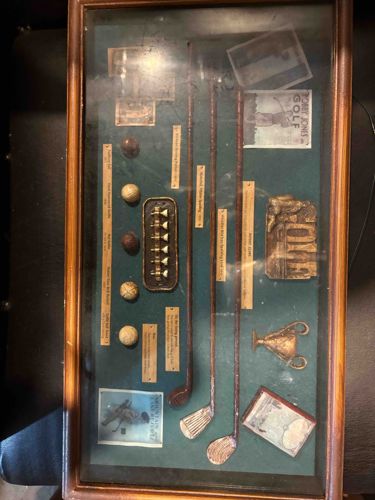
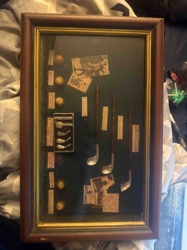
This item is a framed shadow box display titled "Evolution of Golf," showcasing a collection of golf-related artifacts. The display is housed within a wooden frame with a glass front, though the glass appears somewhat smudged and has some glare, obscuring a clear view of all details. The interior features a dark green felt or fabric backing, against which the various items are meticulously arranged. Notable physical characteristics include several golf balls of varying ages and materials, ranging from older, seemingly gutta-percha or feathery types with visible wear and uneven surfaces, to a more modern dimpled white ball. Three golf club heads or partial clubs with wooden shafts are present, exhibiting signs of age, including a dark patina on the wood and some corrosion or tarnishing on the metal club faces. One club appears to be a 'spoon' or similar wood, another a 'mashie' or 'niblick' iron with visible grooves, and a third, possibly a putter or cleek. A small, ornate gold-colored trophy cup with handles is also included, showing some oxidation. There's a rectangular tin box, possibly a container for tees or balls, featuring internal divisions and small, brass-colored pegs, likely tees. Several small, aged paper documents or photographs are visible, some with script or historical golf imagery, one clearly labeled 'TOMMY JONES' GOLF'. Small, yellowed informational labels are placed next to many items, providing context or identification, though their text is largely illegible due to the image quality. The overall condition suggests a vintage or antique collection, with natural wear, discoloration, and patina consistent with age. The arrangement indicates careful curation, aiming to illustrate the historical progression of golf equipment. The craftsmanship is primarily in the display's assembly, showcasing the individual components rather than the display itself being a singular crafted piece. This piece serves as a decorative historical overview of golf.
AI Appraisal Report
I have carefully examined the provided image of the Framed 'Evolution of Golf' Display. Based on the visual evidence, the overall condition suggests a vintage or antique collection, with natural wear, discoloration, and patina consistent with age. The golf balls appear to represent different eras, from gutta-percha to modern, and the club heads display appropriate aging. The tin box and trophy also show age-related oxidation. The arrangement in the shadow box is well-curated, aiming to illustrate a historical progression.
Authenticity, based solely on this image, seems plausible for a period display. The items generally appear consistent with the types of golf artifacts one would expect from various historical periods of the sport. However, definitive authentication is limited without physical inspection. I cannot verify the materials, precise age, or any maker's marks from a photograph. Identifying the specific clubs (e.g., 'mashie' or 'niblick') and confirming the age of the golf balls would require hands-on examination. The documents or photos are illegible, so their historical significance or authenticity cannot be assessed.
Regarding market conditions, historical golf memorabilia has a niche but steady demand, particularly for well-presented, diverse collections. Components such as early golf balls, unique club heads, and related ephemera are sought after. The value here lies more in the curated display itself as a decorative historical piece rather than individual high-value artifacts. Rarity depends on the authenticity and specific historical significance of each piece, which, as noted, cannot be fully determined from the image alone. Factors impacting value include the actual age and rarity of each component, their condition, and the overall aesthetic appeal and integrity of the display.
For full authentication, in-person examination of each item is crucial to assess materials, craftsmanship, and any markings. Provenance documentation for the collection would significantly enhance its value. Scientific testing might be beneficial for materials dating, if warranted.