These notes were written by the person who submitted this item. Appraiser.AI has not verified them, and the AI's identification and estimate may rely on them.
AI Estimated Value
Not an official valuation
$550-750
AI estimate as of September 8, 2025 · verify with a professional before acting
AI-Generated · Verify before acting
Everything on this page is generated by AI for informational purposes only. AI can make mistakes — the AI may misidentify items or misattribute them (artist, maker, brand, designer, origin, era). This is not an official valuation and should not be used for insurance, sale, tax, estate, legal, or lending purposes — or any decision requiring a certified appraisal. It is not an authoritative claim about any person, brand, or rights holder — do not share or rely on it as a factual statement about a third party. Always consult qualified professionals before making financial decisions.
This analysis also relies on unverified notes provided by the user, which may be incomplete or inaccurate and could affect the result.
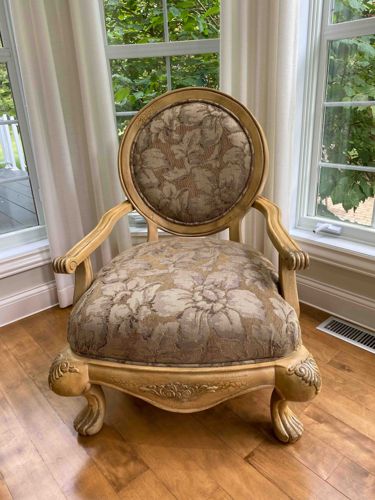
This is a single fauteuil armchair, displaying characteristics of the French Louis XVI style, though it appears to be a later reproduction or revival piece. The chair features a circular, medallion-shaped back with an upholstered panel, and a generously sized, square-shaped seat, also upholstered. The wooden frame, likely constructed from a hardwood such as beech or maple, is finished in a light, possibly distressed or antiqued, cream or light gold paint, giving it an aged patina. The upholstery on both the back and seat is a jacquard fabric, featuring a floral pattern in muted tones of beige, brown, and light green, suggesting a tapestry or brocade weave. The arms are gently curved and extend from the top of the backrest down to support the front of the seat. The legs are cabriole style, with the front two legs adorned with carved acanthus leaves or similar scrolling motifs at the knee, terminating in a paw or scroll foot. A carved apron connects the front legs beneath the seat, featuring an ornate central cartouche or floral swag. The overall craftsmanship appears solid, with no visible major cracks or breaks in the wooden frame. There is some minor wear to the finish on the high points of the carved elements, consistent with light use or intentional distressing. The upholstery shows signs of use, including some slight discoloration and compression of the fabric, but no obvious tears or significant stains are visible from the provided images. The piece exudes an elegant, classical aesthetic, making it suitable for traditional or eclectic interior settings. Its ornate carving and upholstered sections indicate a focus on comfort and decorative appeal.
AI Appraisal Report
Upon examining the provided image and details of this fauteuil armchair, I can confirm it exhibits strong characteristics of the French Louis XVI style, particularly in its medallion back, elegant curves, and carved detailing. Its overall aesthetic aligns with revival pieces from the late 19th or early 20th century, rather than an original 18th-century antique. The light, distressed finish and the nature of the carved 'acanthus leaves or similar scrolling motifs' and 'paw or scroll foot' suggest a later, perhaps even mid-20th-century, reproduction.
From the visual information, the condition appears good for its likely age. There are no visible major structural flaws. The minor wear on the finish is consistent with gentle use or intentional distressing to impart an aged patina. The upholstery, while showing signs of use like slight discoloration and compression, seems intact with no obvious tears, which is a positive factor.
The market for revival French Louis XVI style furniture is steady. While not commanding the high prices of genuine antiques, well-preserved and aesthetically pleasing reproductions are sought after for decorative purposes in traditional or eclectic settings. Comparables would include similar fauteuils from reputable dealers specializing in European revival furniture. Demand is moderate, driven by interior designers and homeowners seeking classic elegance without the premium of true antiquity.
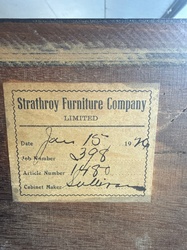
The primary factor impacting value is its status as a reproduction rather than an authentic 18th-century piece. The craftsmanship appears solid, supporting its decorative appeal. To definitively confirm authenticity and precise age, a physical inspection would be crucial for examining joinery, wood type, and construction techniques. Microscopic analysis of the paint layers could determine age, and professional assessment of the upholstery's age and fiber composition would also be beneficial. Without detailed provenance documentation, its exact history remains speculative from images alone.