These notes were written by the person who submitted this item. Appraiser.AI has not verified them, and the AI's identification and estimate may rely on them.
AI Estimated Value
Not an official valuation
$40 - $70
AI estimate as of November 8, 2025 · verify with a professional before acting
AI-Generated · Verify before acting
Everything on this page is generated by AI for informational purposes only. AI can make mistakes — the AI may misidentify items or misattribute them (artist, maker, brand, designer, origin, era). This is not an official valuation and should not be used for insurance, sale, tax, estate, legal, or lending purposes — or any decision requiring a certified appraisal. It is not an authoritative claim about any person, brand, or rights holder — do not share or rely on it as a factual statement about a third party. Always consult qualified professionals before making financial decisions.
This analysis also relies on unverified notes provided by the user, which may be incomplete or inaccurate and could affect the result.
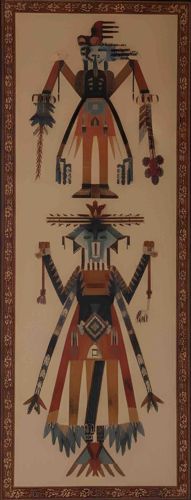
This item is a digital canvas print depicting two stylized Native American Kachina figures rendered in a geometric, almost mosaic-like fashion on a light cream or off-white background. The print is vertical in orientation and features a decorative, intricate border in shades of brown and reddish-brown, mimicking a woven or carved pattern, enclosing the central artwork. Both Kachina figures are highly stylized, composed of angular shapes and lines, suggesting a traditional aesthetic. The upper figure displays a reddish-brown body with black and light blue accents. Its headpiece is elaborate, featuring a red fan-like crest and blue elements. It holds what appears to be a feathered object in its left hand and a cluster of red spherical elements in its right. The lower, larger figure is even more complex, featuring a light blue masked face with subtle features, crowned with a significant dark headdress adorned with brown and black plumes or branches. Its body is a mix of black, reddish-brown, and lighter tan tones, with striking patterns, including a prominent diamond motif on its torso. It holds ritualistic objects in both hands, resembling carved staffs or rattles. Both figures have elongated, decorative limbs. The colors used are earthy and muted, including various shades of brown, tan, red, black, and light blue, characteristic of Native American art. The 'New digital canvas print' context indicates this is a reproduction, likely machine-printed, striving to replicate the detailed texture and color saturation of an original artwork. Given the nature of digital canvas prints, the condition appears excellent with no visible wear, damage, or repairs, as is typical for new reproductions. The craftsmanship lies in the quality of the digital reproduction and printing process, rather than the tactile artistry of an original piece. This piece evokes a mid-20th century to contemporary interpretation of traditional Southwestern Native American art.
AI Appraisal Report
I have examined the provided image and information regarding this Native American Kachina Figure Art Print. Based on the description that this is a 'New digital canvas print,' and the visual evidence, I can assess its condition and authenticity as a reproduction. The print appears to be in excellent, new condition, as expected for a digital reproduction, with no visible wear, damage, or repairs. Given it is a digital canvas print, its authenticity lies not in being an original artwork, but rather in being a high-quality reproduction of an artwork inspired by Native American Kachina figures, rendered in a geometric style.
Market conditions for new digital canvas prints of decorative art are generally stable, but prices are modest. Comparable items, typically mass-produced prints on canvas, range from $30 to $100 depending on size, retailer, and perceived aesthetic quality. Demand for decorative wall art like this is consistent, but it is not rare, as it is a contemporary reproduction. Factors significantly impacting value include its nature as a print rather than an original, and its decorative rather than fine art classification. Because it's a reproduction, collectible value is minimal.
It is crucial to state that my assessment is limited by the fact that this is a digital image. Without physical inspection, I cannot verify the exact quality of the canvas, the print resolution, or the true vibrance and texture of the colors. These details would influence the final perceived quality and market appeal. Full authentication for an original artwork would require provenance documentation, an in-person examination by an expert in Southwestern Native American art, and potentially scientific testing of materials and pigments. However, for a digital print, these concerns are largely moot; the value is primarily decorative.