These notes were written by the person who submitted this item. Appraiser.AI has not verified them, and the AI's identification and estimate may rely on them.
AI Estimated Value
Not an official valuation
$40-75
AI estimate as of September 25, 2025 · verify with a professional before acting
AI-Generated · Verify before acting
Everything on this page is generated by AI for informational purposes only. AI can make mistakes — the AI may misidentify items or misattribute them (artist, maker, brand, designer, origin, era). This is not an official valuation and should not be used for insurance, sale, tax, estate, legal, or lending purposes — or any decision requiring a certified appraisal. It is not an authoritative claim about any person, brand, or rights holder — do not share or rely on it as a factual statement about a third party. Always consult qualified professionals before making financial decisions.
This analysis also relies on unverified notes provided by the user, which may be incomplete or inaccurate and could affect the result.
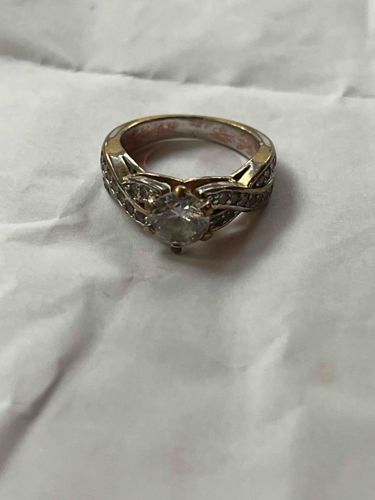
This item is a decorative finger ring, featuring a prominent central clear stone flanked by pave-set smaller accent stones on its bypass style shank. The ring appears to be constructed from two different metallic tones; a brighter silver-colored metal for the main body and setting, and a subtler gold-toned accent visible on the inner band and potentially as subtle accents on the outer bypass elements. The central stone is round-faceted, likely a cubic zirconia or a similar diamond simulant, held securely by at least a six-prong setting. The bypass shank design is elegant, with two intertwining bands forming the upper portion of the ring, each embedded with numerous small round accent stones. These accent stones are also clear and uniform in size, providing significant sparkle. The overall condition shows signs of wear, particularly on the interior of the band where there is visible tarnishing or discoloration, appearing as a reddish-brown patina. This suggests the base metal might be sterling silver or a plated alloy rather than solid gold or platinum, and the gold-toned element could be plating that has worn in some areas. The craftsmanship appears to be of moderate quality, characteristic of fashion jewelry from the late 20th or early 21st century. No distinct maker's marks or signatures are visible in the provided image, but an inspection of the inner band would be necessary to confirm. The ring's design provides a classic yet intricate aesthetic, suitable for everyday wear or as a statement piece.
AI Appraisal Report
Upon examining the image of this Two-Tone Bypass Shank Ring with Central Solitaire and Pave Accents, my assessment of its condition and authenticity is as follows: The ring presents a decorative design, featuring a prominent central round-faceted stone, likely a cubic zirconia or similar diamond simulant, secured by a six-prong setting. The bypass shank is adorned with numerous smaller, clear pave-set accent stones, providing significant sparkle. The two-tone appearance, with a dominant silver-colored metal and subtle gold-toned accents, suggests a plated base metal construction. The visible reddish-brown tarnishing/discoloration on the interior of the band is a key indicator. This patina suggests the base metal is likely sterling silver or a non-precious alloy, rather than solid gold or platinum, and the gold-toned element is likely plating that has worn. This significantly impacts its intrinsic material value.
From a market conditions perspective, this type of fashion jewelry, characterized by its design and materials (simulated stones, plated metals), typically fetches modest prices. Comparables would include mass-produced costume or fashion rings from the late 20th to early 21st century. Demand for such items is generally steady for decorative purposes, but rarity is low given its likely production volume, and there's no indication of a known designer or significant historical provenance.
Factors significantly impacting value are the use of simulated stones and what appears to be plated base metal, as opposed to genuine diamonds and precious metals. The visible wear and tarnishing also reduce its aesthetic and monetary value.
It is crucial to note the limitations in authenticity verification from images alone. A definitive authentication would require an in-person examination to assess specific gravity, hardness, and refractive index of the stones, and to test the metallic composition (e.g., acid testing or XRF analysis) to confirm the exact metals and plating. Furthermore, an in-person inspection of the inner band for any maker's marks, hallmarks, or karat stamps is essential for full authentication and to ascertain potential brand value, though none are visible in the provided image. Without these physical tests, I base my appraisal mainly on the visual cues of materials commonly used in fashion jewelry of this style and condition.