AI estimate as of August 3, 2025 · verify with a professional before acting
AI-Generated · Verify before acting
Everything on this page is generated by AI for informational purposes only. AI can make mistakes — the AI may misidentify items or misattribute them (artist, maker, brand, designer, origin, era). This is not an official valuation and should not be used for insurance, sale, tax, estate, legal, or lending purposes — or any decision requiring a certified appraisal. It is not an authoritative claim about any person, brand, or rights holder — do not share or rely on it as a factual statement about a third party. Always consult qualified professionals before making financial decisions.
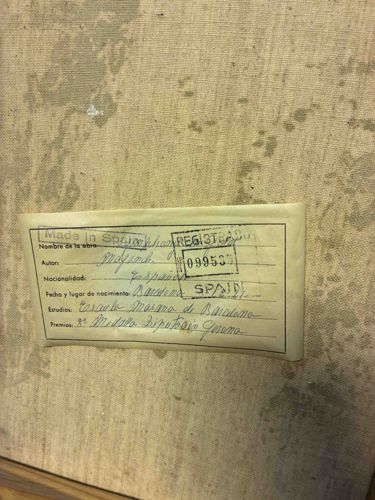
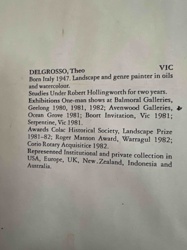
This item is a provenance label or a registration tag, affixed to the reverse side of what appears to be a piece of art, likely a painting given the visible canvas texture in the background. The label is made of aged, light-colored paper, rectangular in shape, and shows signs of discolouration, likely from age and exposure. The edges exhibit some wear and a slight curling, indicating its age and the method of its attachment. The background material is coarse-weave canvas, discolored with various dirt, dust, and water marks, suggesting the artwork has been stored in less than ideal conditions over a prolonged period. The label displays printed fields ('Made in Spain', 'Nombre de la obra', 'Autor', 'Nacionalidad', 'Fecha y lugar de nacimiento', 'Estudios', 'Premios') with handwritten information filled into each, indicating details about the artist and their work. A prominent 'REGISTERED' stamp in black ink is visible, partially obscuring the 'Made in Spain' text, and there is a stamped number '099557' within a rectangular box, likely a registration or inventory number. The handwriting, in what appears to be black ink, is cursive and somewhat faded but mostly legible. The visible condition suggests this item has been affixed to the artwork for a significant period, potentially since its creation or initial registration, making it a crucial piece of historical and provenance information. The 'Made in Spain' and 'REGISTERED' marks suggest an official process, potentially for export, exhibition, or sale.
AI Appraisal Report
Upon examining the provided image of this Art Provenance Label (Spanish), I observe a vintage, rectangular paper label affixed to a coarse-weave canvas, likely the reverse of a painting. The label exhibits significant age-related discoloration, wear, and slight curling at the edges, consistent with prolonged attachment and environmental exposure. The canvas itself shows various marks indicating less-than-ideal storage conditions. The printed fields, such as 'Made in Spain' and artist details, are filled with handwritten cursive ink, which, while somewhat faded, remains mostly legible. A prominent 'REGISTERED' stamp and a numerical stamp '0995557' suggest an official registration or inventory process.
This item's value lies not in the label itself as an independent artifact, but in its critical role as primary source provenance documentation for the artwork it accompanies. Labels like this are fundamental for establishing an artwork's history of ownership and exhibition, directly impacting its market value. The 'Made in Spain' and 'REGISTERED' marks suggest an official origin, potentially for export or formal exhibition, which can enhance an artwork's authenticity and desirability. The condition of the label, while showing age, does not detract from its informational integrity.
Market conditions for such documentation are tied directly to the artwork it authenticates. Without knowing the specific artist or title, assessing demand or rarity for the art piece is impossible. However, the presence of such a detailed, period-appropriate label generally adds measurable value to an artwork by reducing provenance risk and increasing buyer confidence. Conversely, the absence of this label on the artwork would be a significant red flag.
Factors significantly impacting value are the completeness and legibility of the information, and critically, the identity and reputation of the artist named on the label. This label serves as a verifiable historical document that strengthens the artwork's authenticity claim.
My assessment of authenticity regarding the label itself is that it appears period-appropriate and genuine based on visual cues such as paper aging, ink fading, and printing style. However, this is a limitation without physical examination. For full authentication of *the artwork*, in-person examination would be crucial to assess the artwork's stylistic congruence with the artist, the physical condition of the canvas and paint, and potential forensic analysis of materials. For the *label*, tactile inspection for paper fiber, ink composition analysis, and comparison with known archival examples from the same period and institution would be invaluable. Cross-referencing the registration number and artist details with any official archives or catalogs would also be essential for definitive authentication of the provenance claim.