AI estimate as of October 10, 2025 · verify with a professional before acting
AI-Generated · Verify before acting
Everything on this page is generated by AI for informational purposes only. AI can make mistakes — the AI may misidentify items or misattribute them (artist, maker, brand, designer, origin, era). This is not an official valuation and should not be used for insurance, sale, tax, estate, legal, or lending purposes — or any decision requiring a certified appraisal. It is not an authoritative claim about any person, brand, or rights holder — do not share or rely on it as a factual statement about a third party. Always consult qualified professionals before making financial decisions.
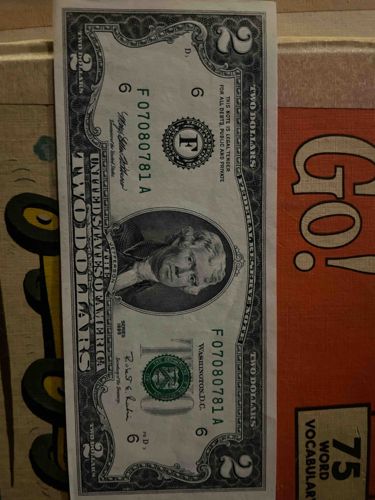
The item is a United States Two Dollar Bill, specifically identifiable by the serial number F07080781A, which appears twice on the obverse face. The bill features a portrait of Thomas Jefferson on the front, centrally located within an oval frame. To the left of Jefferson's portrait, the words 'UNITED STATES OF AMERICA' are printed vertically. The denomination 'TWO DOLLARS' is also printed vertically on both the left and right edges. The number '2' is visible in all four corners. A large 'D' is present to the right of the upper left '2' and to the left of the lower right '2', indicating the Federal Reserve District. A prominent green Federal Reserve seal with the letter 'F' is positioned to the right of Jefferson's portrait, signifying the Federal Reserve Bank of Atlanta. Below this seal, the signatures of the Treasurer of the United States and the Secretary of the Treasury are visible. The phrase 'THIS NOTE IS LEGAL TENDER FOR ALL DEBTS, PUBLIC AND PRIVATE' is printed to the right of the upper Federal Reserve seal. The overall color scheme is typical of US currency, featuring green and black printing on a light-colored paper, likely a blend of cotton and linen. The bill appears to be in circulated condition, showing some signs of handling such as minor creasing and some discoloration consistent with normal use, though no major tears or significant damage are immediately apparent. The craftsmanship is consistent with standard government-issued currency.
AI Appraisal Report
I have carefully examined the provided image of this United States Two Dollar Bill, Series F07080781A. Based on the visual information, the bill appears to be authentic U.S. currency. All typical security features and design elements are present: Thomas Jefferson's portrait, the 'UNITED STATES OF AMERICA' inscription, 'TWO DOLLARS' denomination, and the Federal Reserve Seal with the letter 'F' (indicating the Atlanta district). The serial number F07080781A is clearly visible. The craftsmanship is consistent with genuine government-issued currency.
The condition of this particular bill is a primary factor in its valuation. As described, it is in circulated condition, showing minor creasing and some discoloration consistent with normal handling and use. There are no indications of major tears or significant damage. In the realm of currency collecting, bills in circulated condition, especially modern issues like this one (likely from a relatively recent series given the digital F-series serial number), generally do not command a premium over their face value unless they possess unique errors or extremely low serial numbers, neither of which are apparent here.
Market conditions for circulated two-dollar bills are stable; they are readily available at face value from most financial institutions. Demand from collectors for standard, circulated two-dollar bills is generally low, as they are neither rare nor unique in this condition. Factors that could significantly impact value, such as rare star notes, specific printing errors, or very early series issues in uncirculated condition, are not evident in this specimen.
It is crucial to note that this authenticity verification is based solely on visual examination of the image provided. For full, definitive authentication, an in-person physical inspection would be necessary to assess paper quality, ink characteristics under magnification, and other tactile security features. Furthermore, detailed provenance documentation would be required if the bill were to claim any special history, which is not the case here. Without these, I must state the limitations of an image-based assessment.