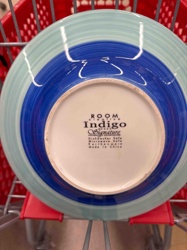
These notes were written by the person who submitted this item. Appraiser.AI has not verified them, and the AI's identification and estimate may rely on them.
AI Estimated Value
Not an official valuation
$25-45
AI estimate as of July 12, 2025 · verify with a professional before acting
AI-Generated · Verify before acting
Everything on this page is generated by AI for informational purposes only. AI can make mistakes — the AI may misidentify items or misattribute them (artist, maker, brand, designer, origin, era). This is not an official valuation and should not be used for insurance, sale, tax, estate, legal, or lending purposes — or any decision requiring a certified appraisal. It is not an authoritative claim about any person, brand, or rights holder — do not share or rely on it as a factual statement about a third party. Always consult qualified professionals before making financial decisions.
This analysis also relies on unverified notes provided by the user, which may be incomplete or inaccurate and could affect the result.
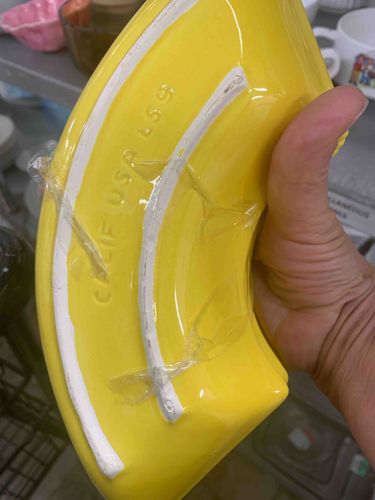
The item appears to be a vintage ceramic banana-shaped dish or bowl, likely intended as a serving piece or decorative accent. Its primary physical characteristic is a vibrant, glossy yellow glaze covering most of its exterior, mimicking the color of a ripe banana. The underside, visible in the image, reveals an unglazed or white-glazed ridge running along its length and what seems to be another raised, unglazed element, possibly for stability or a design feature. Carved or impressed text on the base clearly reads "CALIF USA L59", indicating both its origin and a potential model or mold number. The 'CALIF USA' suggests it was manufactured in California, USA, likely by a pottery or ceramics company. There is clear evidence of plastic wrap clinging to its surface, indicating it might have come from a retail environment, possibly a thrift store, and was wrapped for protection or transport. The overall construction suggests a molded ceramic piece, with smooth curves and a uniform finish on the glazed areas. The condition appears to be good, with no immediately visible chips, cracks, or significant wear, although the plastic wrap obscures some detailed inspection. The craftsmanship appears to be commercial grade, typical of mid-20th-century American ceramics. Given the 'L59' marking, it's plausible that '59' refers to the year of manufacture, placing its estimated age in the late 1950s. This period aligns with the popular use of bright, often fruit-themed, ceramic housewares. The item's unique aspect is its specific banana shape, which would have made it distinctively functional for serving bananas or as a novel decorative piece.
AI Appraisal Report
Upon examining the provided image of this banana-shaped dish, I can identify it as a piece of vintage California Pottery. The clear markings 'CALIF USA L59' on the unglazed base are characteristic of numerous potteries operating in California during the mid-20th century. My assessment is that the 'L59' likely corresponds to a model or mold number, and potentially the year 1959, placing it firmly in the mid-century modern era.
The dish presents in what appears to be very good condition, with a vibrant, glossy yellow glaze and no visible chips or cracks, although the presence of plastic wrap slightly obscures a full surface inspection. The authenticity is strongly suggested by the style, markings, and form, which are consistent with this type of decorative houseware. However, without a physical examination, I cannot definitively rule out a reproduction or check for hairline cracks or repairs that are not visible in the photograph.
Market demand for California Pottery remains steady, particularly for figural and brightly colored pieces. This banana dish is a whimsical and collectible example. Based on recent sales of similar marked California Pottery and Lane & Co. items (Lane frequently used 'L' prefixes), comparable novelty dishes in this condition command a modest value. The primary value driver is its excellent display quality and nostalgic appeal. Full authentication would require physical inspection to check for crazing or repairs, and to more precisely identify the specific maker among the many California potteries (like Lane & Co., which is a strong possibility).