AI identification & appraisal estimate

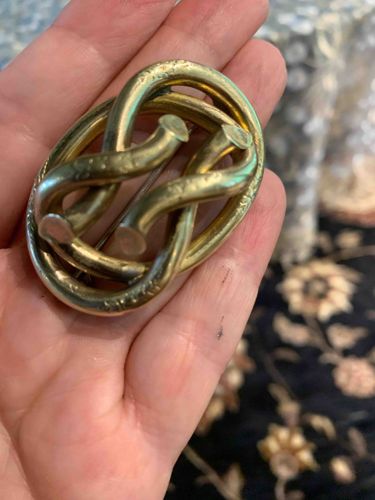
Victorian Gilded Love Knot Brooch

Submitted photo of Victorian Gilded Love Knot Brooch
Photo submitted by the user — not generated by AI

User's notes

C1880 love knot brooch

These notes were written by the person who submitted this item. Appraiser.AI has not verified them, and the AI's identification and estimate may rely on them.

AI Estimated Value

Not an official valuation

$65 - $95

AI estimate as of July 31, 2025 · verify with a professional before acting

AI-Generated · Verify before acting

Everything on this page is generated by AI for informational purposes only. AI can make mistakes — the AI may misidentify items or misattribute them (artist, maker, brand, designer, origin, era). This is not an official valuation and should not be used for insurance, sale, tax, estate, legal, or lending purposes — or any decision requiring a certified appraisal. It is not an authoritative claim about any person, brand, or rights holder — do not share or rely on it as a factual statement about a third party. Always consult qualified professionals before making financial decisions.

This analysis also relies on unverified notes provided by the user, which may be incomplete or inaccurate and could affect the result.

Read the full disclaimer

AI Item Analysis

The item is a Victorian-era love knot brooch, likely constructed from gilded base metal, possibly brass or copper, given the warm golden hue and visible signs of wear exposing areas of underlying metal or patina. Its design features an intricate interwoven knot pattern, comprising several overlapping cylindrical or tubular elements, creating a three-dimensional, symmetrical oval shape. The brooch appears to be approximately 1.5 to 2 inches in length based on its appearance in a human hand. The 'knot' forms a classic love knot, symbolic of eternal love and commitment, popular during the Victorian period. Notable features include the textured surface, which shows faint, irregular striations or perhaps remnants of a chased or engraved pattern, particularly visible on the outer loops. The surface exhibits significant wear and light scratches consistent with age and use, especially on the raised areas. There is a noticeable dark greenish-brown patina in the recessed areas and along the edges, indicative of oxidation over time. No explicit maker's marks or signatures are clearly discernible from the provided images, but the crafting suggests a mass-produced, yet well-finished, piece characteristic of the late 19th-century jewelry market. The reverse side, partially visible, shows a simple pin mechanism typical of brooches from this era. The quality of craftsmanship is generally good for its type, with smooth curves and a well-formed knot. The overall condition, while showing wear, is robust, suggesting it has been preserved reasonably well for its estimated age of C1880.
AI Appraisal Report

Upon examination of the provided images and details, I have assessed this Victorian love knot brooch. The piece presents as a characteristic example from its stated era, circa 1880. Its design, featuring an interwoven knot symbolic of eternal love, was highly popular during the period. The construction appears to be gilded base metal, likely brass, which is consistent with many commercially produced pieces of the time. The visible wear, including the thinning of the gilding on raised surfaces and the development of a dark patina in recessed areas, is consistent with its age and use, lending credence to its authenticity as a period item. The market for Victorian costume jewelry is steady, driven by collectors and enthusiasts of historical fashion. While not considered fine jewelry due to its base metal construction, well-preserved examples like this one hold value for their historical and aesthetic appeal. Similar gilded Victorian brooches in good condition typically sell in a consistent range. The primary factors impacting its value are its condition and the lack of precious metals or gemstones. Its value lies in its design, historical context, and decorative quality rather than intrinsic material worth. It is crucial to note the limitations of an appraisal based solely on images. Without physical inspection, I cannot definitively confirm the base metal composition, test the gold layer, or thoroughly examine for any subtle maker's marks that might be present. A full authentication would require an in-person examination, including possible non-invasive X-ray fluorescence (XRF) testing to identify the specific metals used.

Keep exploring

More jewelry appraisals

Get your items appraised

Instant AI-powered appraisal estimates from a photo

Browse More Appraisals