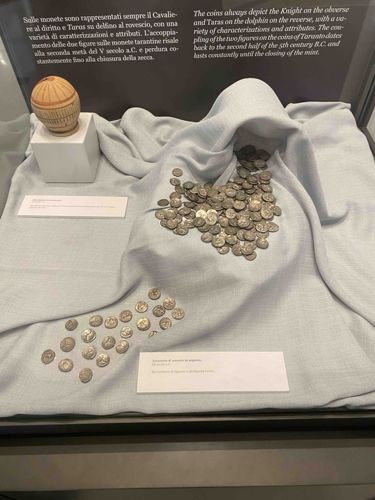
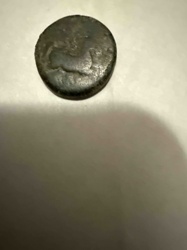
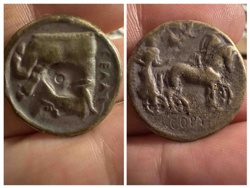
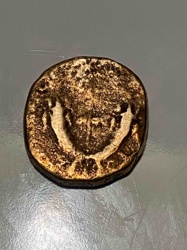
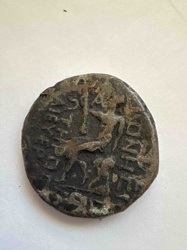
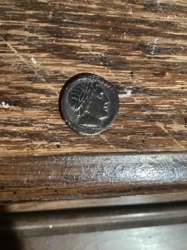
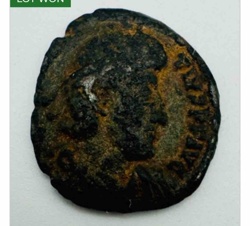
Tesoretto di monete in argento III secolo a.C. Dal territorio di Egnazia (c.da Signora Cecca).
These notes were written by the person who submitted this item. Appraiser.AI has not verified them, and the AI's identification and estimate may rely on them.
AI Estimated Value
Not an official valuation
$45,000-65,000
AI estimate as of August 16, 2025 · verify with a professional before acting
AI-Generated · Verify before acting
Everything on this page is generated by AI for informational purposes only. AI can make mistakes — the AI may misidentify items or misattribute them (artist, maker, brand, designer, origin, era). This is not an official valuation and should not be used for insurance, sale, tax, estate, legal, or lending purposes — or any decision requiring a certified appraisal. It is not an authoritative claim about any person, brand, or rights holder — do not share or rely on it as a factual statement about a third party. Always consult qualified professionals before making financial decisions.
This analysis also relies on unverified notes provided by the user, which may be incomplete or inaccurate and could affect the result.
The item is a hoard of ancient silver coins, likely denarii or similar small silver denominations, dating from the 3rd century BCE. Discovered in the territory of Egnazia, specifically in the Contrada Signora Cecca region, these coins are presented as a 'Tesoretto di monete in argento' (treasure of silver coins). Visually, the coins appear to be relatively small in diameter, consistent with ancient currency, and are irregular in shape, indicating hand-striking methods rather than modern machine-pressed uniformity. They exhibit a dull, greyish-silver patina, typical of aged silver that has been buried or exposed to elements over millennia. There's visible wear on many of the coins, with some details of the figures and inscriptions, though generally discernible, being softened or partially worn away. This wear is expected for ancient coinage that has circulated and been subject to natural environmental conditions over centuries. No specific maker's marks are clearly visible from the image, but the accompanying text indicates that these are Taras coins, consistently depicting a Knight on the obverse and Taras on a dolphin on the reverse. This particular coupling of figures dates back to the second half of the 5th century BCE and continued until the mint's closure, providing a strong stylistic identifier and age estimation. The hoard includes a large pile of coins gathered on a light grey, linen-like fabric, suggesting a deliberate presentation for display, possibly in a museum or archaeological exhibit, along with a smaller, more spread-out group of coins visible on the lower left, allowing for individual examination. The overall condition suggests careful conservation efforts, with no obvious signs of recent damage or repair. The quality indicators point to genuine ancient artifacts, valued for their historical and numismatic significance.
AI Appraisal Report
Upon examining the provided image and textual description, I assess this Egnazia Silver Coin Hoard from the 3rd Century BCE to be a collection of genuine ancient artifacts. The coins exhibit characteristics consistent with hand-struck ancient currency: irregular shapes, varying diameters, and a dull, greyish-silver patina indicative of millennia of burial and exposure. The visible wear, while obscuring some finer details, is expected for circulating coinage of this age and points to authenticity rather than modern fabrication. The consistent iconography of a Knight on the obverse and Taras on a dolphin on the reverse strongly supports their identification as Taras coins, dating them reliably to the specified period.
Market conditions for ancient coin hoards are generally robust, driven by both numismatic collectors and institutions. The historical significance of a hoard, especially one with known provenance from a specific archaeological site like Egnazia, significantly enhances its value. Rarity is high for intact hoards of this size and age; while individual Taras coins are available, a large, cohesive hoard is less common. Demand is consistently strong for historically significant artifacts.
Factors significantly impacting value include the number of coins, their individual preservation (despite overall wear), and the clear archaeological context. However, a crucial limitation is authenticating from images alone. While everything points to authenticity, a definitive appraisal requires in-person examination to assess specific Gravity, metal composition, and strike details. Provenance documentation, such as official archaeological reports, would further solidify value. Scientific testing, like XRF analysis, could confirm metal purity and composition. Without these, my appraisal is based on visual and contextual data. A full authentication would necessitate direct physical inspection by a numismatic expert.