AI identification & appraisal estimate

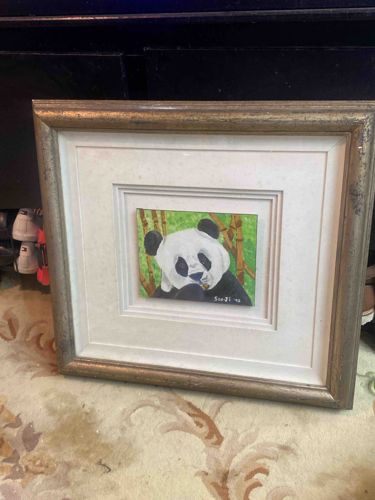
Original Panda Painting by Soo-Ji

Submitted photo of Original Panda Painting by Soo-Ji
Photo submitted by the user — not generated by AI

User's notes

Artist : SooJi-98 or could be 48

These notes were written by the person who submitted this item. Appraiser.AI has not verified them, and the AI's identification and estimate may rely on them.

AI Estimated Value

Not an official valuation

$450 - $700

AI estimate as of March 21, 2026 · verify with a professional before acting

AI-Generated · Verify before acting

Everything on this page is generated by AI for informational purposes only. AI can make mistakes — the AI may misidentify items or misattribute them (artist, maker, brand, designer, origin, era). This is not an official valuation and should not be used for insurance, sale, tax, estate, legal, or lending purposes — or any decision requiring a certified appraisal. It is not an authoritative claim about any person, brand, or rights holder — do not share or rely on it as a factual statement about a third party. Always consult qualified professionals before making financial decisions.

This analysis also relies on unverified notes provided by the user, which may be incomplete or inaccurate and could affect the result.

Read the full disclaimer

AI Item Analysis

This is a small-format original painting depicting a giant panda amidst a bamboo background. The artwork appears to be executed in oil or acrylic on a canvas board or mounting. The panda is rendered with a focus on its distinctive black and white patterns, shown in a seated or reclining pose chewing on bamboo. The style is representational with expressive brushwork, particularly visible in the green and brown bamboo stalks in the background. A notable feature is the artist's signature 'Soo-Ji' followed by the number '98' (likely 1998) located in the lower right corner. The painting is housed in an elaborate, deep-set professional framing system. The frame features a wide, champagne-silver or tarnished gold metallic outer molding with a distressed patina, followed by a multi-stepped white fabric-covered liner (mat) that creates a 'shadow box' effect, giving the small artwork significant visual depth. The craftsmanship of the framing indicates a high-end presentation relative to the size of the piece. Condition appears good, with no visible flaking or cracking of the paint surface, though the frame shows intentional aged distressing and potential light surface dust on the matting. The style is late 20th-century contemporary animalier art.

AI Appraisal Report

I have conducted a visual examination of this original animalier work by the artist signed 'Soo-Ji,' dated 1998. The piece is an intimate, representational study of a giant panda, demonstrating competent handle of impasto and brushwork in the bamboo background. The condition appears excellent; the paint film shows no evidence of craquelure, delamination, or yellowing of the varnish. The high-end, deep-set professional framing—featuring a silver-gilt molding and a recessed fabric liner—is of significant quality, likely representing a substantial portion of the item's initial acquisition cost and adding clear decorative value. Market demand for 'panda art' remains steady, though often driven by decorative appeal rather than name-brand recognition in this specific artist's case. Similar small-format 20th-century animal portraits by regional artists typically realize prices in the mid-hundreds at auction. The value is bolstered here by the sophisticated presentation, which positions the piece as a complete 'gallery-ready' object. Limitations: This appraisal is based on a digital surrogate. Photographs cannot confirm the nature of the substrate or detect subtle overpainting without UV light. To fully authenticate the work, I would require an in-person inspection to verify the medium (acrylic vs. oil) and review provenance documentation or a sales receipt from the original gallery. Scientific testing of pigments would only be necessary if the '98' signature were suspected to be 1948, though stylistically, 1998 is more consistent with the materials and framing style observed.

Keep exploring

More fine art - paintings appraisals

Get your items appraised

Instant AI-powered appraisal estimates from a photo

Browse More Appraisals