AI estimate as of November 18, 2025 · verify with a professional before acting
AI-Generated · Verify before acting
Everything on this page is generated by AI for informational purposes only. AI can make mistakes — the AI may misidentify items or misattribute them (artist, maker, brand, designer, origin, era). This is not an official valuation and should not be used for insurance, sale, tax, estate, legal, or lending purposes — or any decision requiring a certified appraisal. It is not an authoritative claim about any person, brand, or rights holder — do not share or rely on it as a factual statement about a third party. Always consult qualified professionals before making financial decisions.
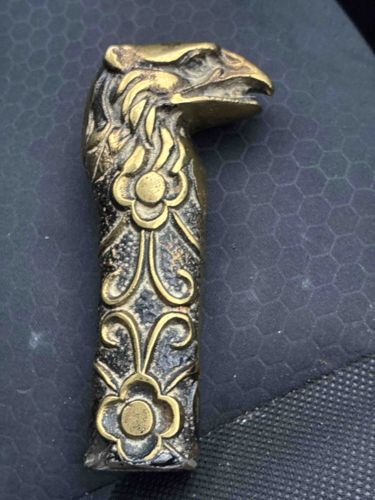
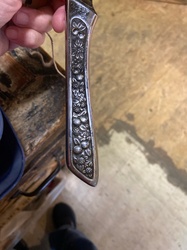
This is a decorative handle or finial, likely crafted from brass, distinguished by its prominent eagle head terminal and an elaborately engraved floral shaft. The item exhibits a rich, aged brass color with areas of darker patination, particularly in the recessed sections of the design, which enhances the visual depth and contrast of the raised golden-hued elements. The eagle's head is finely detailed, featuring a sharp, curved beak, distinct eyes, and plumage rendered with carved lines suggesting feathers. The shaft below the eagle's head is adorned with a repeating floral pattern, characterized by stylized blossoms and swirling vine-like motifs. Each flower consists of several petals surrounding a central circular element. The craftsmanship suggests a cast rather than hand-forged piece, with the details further refined through engraving or chasing. The overall condition shows signs of age-appropriate wear, including some minor surface abrasions and the aforementioned desirable natural darkening or oxidation of the metal. There are no obvious signs of significant damage, repairs, or breakage, indicating it has been relatively well preserved. The style, with its combination of animalistic and botanical themes, suggests a period influence that could range from late 19th to early 20th century, potentially intended for a walking stick, umbrella, or an ornamental cabinet. The detailed work and solid construction indicate a good quality item, likely produced by skilled artisans rather than mass-produced. The back detail, though not fully visible, seems to continue the floral design or have a complementary texture.
AI Appraisal Report
This decorative handle, featuring an eagle head terminal and an elaborately engraved floral shaft, presents as a well-crafted piece from my visual examination of the image. The material appears to be brass, with an attractive aged patination that enhances the detailed design. The eagle's head is finely rendered, and the floral motifs on the shaft are intricate, suggesting skilled artistry. The overall condition appears good, with age-appropriate wear and no visible significant damage or repairs. The casting quality and subsequent refinement through engraving or chasing point to a good quality, likely artist-made item rather than a mass-produced one.
Authenticity, based solely on imagery, suggests an origin from the late 19th to early 20th century, consistent with the style of combining zoomorphic and botanical elements often found in items such as walking stick handles or decorative finials.
Market conditions for such brass decorative items are steady but not high-flying. While these historical pieces are appreciated by collectors of antique hardware or militaria, they are not exceedingly rare unless definitively attributed to a renowned maker or possess significant historical provenance. Demand exists, particularly for well-preserved examples like this one, but it is not a highly competitive market segment. Comparables would include similar antique brass handles or finials, typically ranging from $100 for simpler designs to $300+ for exceptionally detailed or historically significant pieces.
Factors significantly impacting its value include its excellent state of preservation, the intricate detailing, and the appealing aged patination. Without an in-person examination, it's impossible to confirm the exact metal composition or manufacturing techniques (e.g., distinguishing between true engraving vs. heavy chasing). Furthermore, a lack of provenance documents limits the ability to tie it to a specific historical event, maker, or original purpose, which could substantially increase its value. A physical inspection would allow for measurement, weight assessment, and microscopic examination of the surface to confirm authenticity, identify any hidden repairs, and provide more precise dating based on metallurgical analysis or construction methods.