AI estimate as of August 24, 2025 · verify with a professional before acting
AI-Generated · Verify before acting
Everything on this page is generated by AI for informational purposes only. AI can make mistakes — the AI may misidentify items or misattribute them (artist, maker, brand, designer, origin, era). This is not an official valuation and should not be used for insurance, sale, tax, estate, legal, or lending purposes — or any decision requiring a certified appraisal. It is not an authoritative claim about any person, brand, or rights holder — do not share or rely on it as a factual statement about a third party. Always consult qualified professionals before making financial decisions.
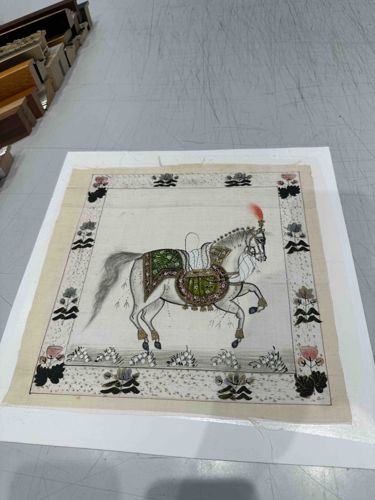
This item is an unframed, square-format miniature painting depicting a caparisoned horse, rendered in what appears to be a traditional Indian or Persian style. The painting is executed on a light-colored, possibly silk or fine paper, ground. The central motif is a white or light-grey horse, shown in active motion with one leg lifted, suggesting a prancing or galloping posture. The horse is elaborately adorned with a rich green saddle blanket and bridle, detailed with what appear to be gold or brass accents and possibly jewels. A distinctive red plume adorns the horse's headpiece. The background is minimalist, suggesting rolling hills or a subtle landscape with sparse vegetation, providing focus on the horse. The painting features a decorative border around its perimeter, consisting of stylized floral and foliate motifs in muted greens, blues, and browns on a lighter, possibly off-white, background. The craftsmanship appears delicate, with fine brushwork evident in the horse's mane and tail, as well as the intricate details of its ornamentation. There are no visible prominent manufacturer's marks or signatures, though such details might be on the reverse or obscured. The overall condition appears good, with no obvious major tears, creases, or significant discoloration, though minor imperfections from age or handling might be present upon closer inspection. The style suggests it could date from the 18th to early 20th century, common periods for such miniature works. The colors are generally well-preserved, and the intricate details point to a high degree of artistic skill, indicative of quality craftsmanship.
AI Appraisal Report
Upon visual examination of the provided image, I assess this unframed miniature painting of a caparisoned horse to be in good overall condition. The colors appear well-preserved, and there are no obvious major tears, creases, or significant discoloration. The fine brushwork and intricate detailing, particularly in the horse's ornamentation and the decorative border, suggest quality craftsmanship typical of Indian miniature paintings. While the style points to an 18th to early 20th-century origin, confirming authenticity solely from an image is impossible. I cannot verify the type of ground (silk vs. fine paper) or the presence of hidden marks. A physical examination is crucial to determine minute imperfections, the true material, and the age of the pigments. Provenance documentation would significantly enhance certainty regarding its origin, artist, and historical context. Scientific testing, such as pigment analysis, could further confirm its age and authenticity. Market demand for well-preserved Indian miniatures remains steady, especially for pieces exhibiting high artistic merit and intricate detail like this one. However, without confirmed provenance or signature, its value is primarily based on aesthetic appeal and presumed age. Compared to fully authenticated pieces, its value will be conservatively estimated due to these uncertainties. The primary factors impacting value here are the presumed age, condition, and artistic skill, balanced against the lack of definitive provenance or signature.