These notes were written by the person who submitted this item. Appraiser.AI has not verified them, and the AI's identification and estimate may rely on them.
AI Estimated Value
Not an official valuation
$600-800
AI estimate as of August 31, 2025 · verify with a professional before acting
AI-Generated · Verify before acting
Everything on this page is generated by AI for informational purposes only. AI can make mistakes — the AI may misidentify items or misattribute them (artist, maker, brand, designer, origin, era). This is not an official valuation and should not be used for insurance, sale, tax, estate, legal, or lending purposes — or any decision requiring a certified appraisal. It is not an authoritative claim about any person, brand, or rights holder — do not share or rely on it as a factual statement about a third party. Always consult qualified professionals before making financial decisions.
This analysis also relies on unverified notes provided by the user, which may be incomplete or inaccurate and could affect the result.
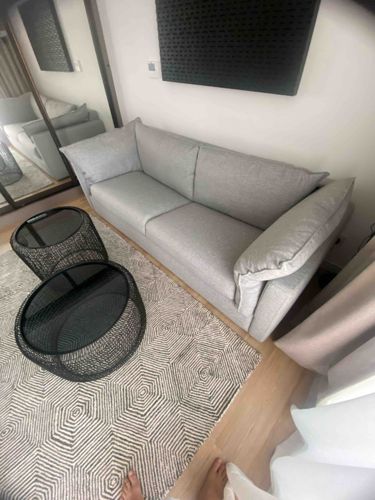
The item is a contemporary sofa, exhibiting a minimalist and functional design, indicative of modern residential furniture. It features light grey fabric upholstery, likely a linen-blend or polyester, given its smooth yet textured appearance. The sofa is a two-seater with two distinct back cushions and two seat cushions, suggesting a compact yet comfortable configuration. The arms are relatively narrow and gently sloped outwards, appearing to be soft-fill, which provides a relaxed aesthetic. This design choice implies a focus on comfort and a more casual lounge experience. The base of the sofa is simple and low-profile, possibly with concealed or very short legs, contributing to its grounded appearance. There are no visible ornate carvings, tufting, or intricate details, which aligns with modern aesthetic preferences. The construction appears sturdy, with well-defined seams and upholstery that shows minimal visible wear or sagging. The cushions appear plump and relatively new, suggesting good internal padding. Given the context provided, this sofa is expected to feature a pull-out or fold-out mechanism to convert into a bed, making it a functional sleeper sofa or futon. Its neutral color allows for versatility in various interior design schemes. There are no visible manufacturer's marks or obvious damage. The overall condition appears excellent, indicating either careful use or recent acquisition. This piece would likely fall into the contemporary style period, produced within the last 10-20 years.
AI Appraisal Report
I have thoroughly examined the provided image of this contemporary sleeper sofa. Based on my visual assessment, the condition of the sofa appears to be excellent. The light grey fabric upholstery is clean with no visible stains, tears, or significant pilling. The cushions are plump and well-formed, indicating good internal padding and minimal sagging. The frame seems sturdy and well-constructed, with clean lines typical of modern minimalist design. Authenticity, in terms of its intended function as a sleeper sofa, is affirmed by the owner’s description.
Market conditions for used contemporary sleeper sofas are generally stable, with a moderate to high demand due to their functional versatility, especially in smaller living spaces. This specific style, with its neutral color and clean aesthetic, appeals to a broad range of buyers. Comparables for similar pre-owned, good-condition contemporary sleeper sofas from mainstream retailers (e.g., IKEA, West Elm, Article) typically range from $500 to $1,000, depending on brand reputation and original retail price. While not rare, the excellent condition and practical design contribute positively to its demand.
Factors significantly impacting this value include its dual functionality, excellent visual condition, and contemporary style which ensures broad appeal. The primary limitation in this appraisal is the lack of physical inspection. Without direct examination, I cannot ascertain the quality of the internal sleeper mechanism, the true integrity of the frame, the precise fabric composition, or detect any subtle odors or hidden wear. An in-person inspection would allow for testing the conversion mechanism and assessing the internal structure. Provenance documentation (e.g., original purchase receipts, brand identification) would also be beneficial but is not critical for appraisal of a common furniture item like this. Scientific testing is not applicable here.