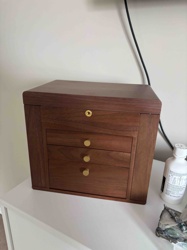
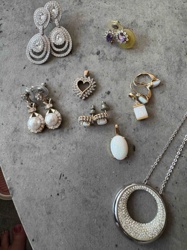
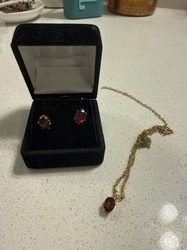
These notes were written by the person who submitted this item. Appraiser.AI has not verified them, and the AI's identification and estimate may rely on them.
AI Estimated Value
Not an official valuation
$600-900
AI estimate as of December 10, 2025 · verify with a professional before acting
AI-Generated · Verify before acting
Everything on this page is generated by AI for informational purposes only. AI can make mistakes — the AI may misidentify items or misattribute them (artist, maker, brand, designer, origin, era). This is not an official valuation and should not be used for insurance, sale, tax, estate, legal, or lending purposes — or any decision requiring a certified appraisal. It is not an authoritative claim about any person, brand, or rights holder — do not share or rely on it as a factual statement about a third party. Always consult qualified professionals before making financial decisions.
This analysis also relies on unverified notes provided by the user, which may be incomplete or inaccurate and could affect the result.
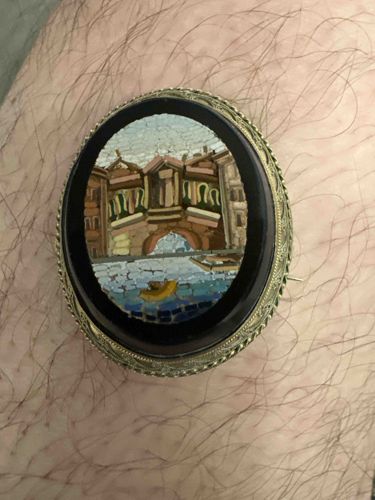
This is an oval-shaped vintage Italian micro mosaic brooch featuring a detailed depiction of what appears to be the Rialto Bridge in Venice. The central mosaic is exceptionally fine, composed of countless minute tesserae that create a picturesque canal scene. The bridge itself is rendered in shades of brown, beige, and olive green, with architectural details clearly visible. Below the bridge, the canal waters are portrayed with a spectrum of blue and white tesserae, and a lone yellow gondola-like boat is centrally positioned. The mosaic is set within a black border, which in turn is encased by an ornate gilt metal or yellow gold-filled frame. This outer frame exhibits intricate filigree or chased work, featuring a repeating pattern of scrolls and perhaps a beaded edge, indicating fine craftsmanship. The tesserae appear to be well-preserved, with no obvious missing pieces, though a slight discoloration or darkening of the grout might be present from age. The overall condition suggests it has been cared for, though the reverse side, which would reveal the pin mechanism and any maker's marks, is not visible. Given the style and fine detail of the micro mosaic, this piece likely dates from the late 19th to early 20th century. The craftsmanship is high quality, especially evident in the precision of the mosaic work and the decorative metal setting. The size appears to be substantial, suitable as a statement piece.
AI Appraisal Report
Based on my visual examination of this vintage Italian micro mosaic brooch depicting the Rialto Bridge, I assess its condition to be very good to excellent. The mosaic work is exceptionally detailed and intact, with no observable missing tesserae, which is a significant factor for micro mosaic pieces. The gilt metal or gold-filled frame exhibits intricate filigree, indicative of quality craftsmanship. The presence of a single yellow gondola adds a charming touch. The stylistic elements, particularly the fine tesserae and common motif, strongly suggest an authentic late 19th to early 20th-century Italian origin.
Market conditions for vintage micro mosaics, especially well-preserved scenic pieces like this, remain consistently strong. Comparables for similar high-quality Italian micro mosaic brooches, particularly those with iconic Venetian scenes and ornate mountings, typically range from $500 to over $1,000 depending on size, intricacy, and material of the setting. The high level of detail in the canal scene and the intact nature of the tesserae contribute to its desirability. While not exceedingly rare, pieces in this condition with such fine artistry are less common, driving demand among collectors of antique jewelry.
The most significant factors impacting value are the exceptional condition of the mosaic, the detailed craftsmanship of both the mosaic and the setting, and the iconic subject matter. Without physical inspection, I cannot definitively confirm the metal purity of the frame (e.g., solid gold versus gold-filled) or examine the pin mechanism for structural integrity and potential repairs. Full authentication and a more precise valuation would benefit from in-person examination to verify the metal composition, check for hidden damage or repairs, and identify any maker's marks, as well as scrutinize the tesserae for exact material and craftsmanship techniques. Provenance documentation, if available, would further enhance authentication.