AI estimate as of November 18, 2025 · verify with a professional before acting
AI-Generated · Verify before acting
Everything on this page is generated by AI for informational purposes only. AI can make mistakes — the AI may misidentify items or misattribute them (artist, maker, brand, designer, origin, era). This is not an official valuation and should not be used for insurance, sale, tax, estate, legal, or lending purposes — or any decision requiring a certified appraisal. It is not an authoritative claim about any person, brand, or rights holder — do not share or rely on it as a factual statement about a third party. Always consult qualified professionals before making financial decisions.
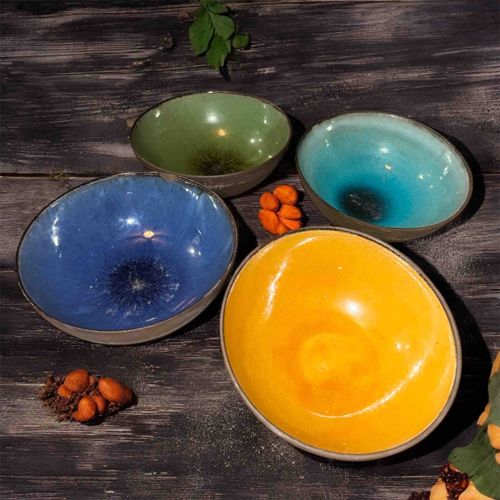
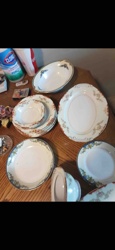
This is a set of four individually crafted ceramic bowls, each featuring a unique, vibrant glazed interior and a contrasting unglazed or matte exterior. The bowls are roughly hemispherical in shape, with slightly irregular, organically shaped rims, suggesting handmade craftsmanship. The interior glazes present a diverse color palette: one bowl is a rich royal blue with subtle white or lighter blue streaks radiating from the center, creating a starburst or crystalline effect; another is a deep turquoise or teal, transitioning to a darker, almost black center; a third bowl displays a bright, sunny yellow with an orange undertone, having a slightly mottled or textured appearance within the glaze; and the fourth bowl is glazed in a vibrant olive or lime green, with a darker, more textured patch in its center, possibly reminiscent of moss or deep vegetation. The exterior of all bowls appears to be a natural, unglazed earthenware or stoneware in a neutral, light gray or beige tone, providing a rustic contrast to the glossy interiors. Each bowl exhibits a rim that is slightly thicker where the interior glaze meets the raw ceramic, showing careful but individual application. There are no visible chips, cracks, or significant wear, and the glazes appear intact and lustrous. The variations in glaze application and coloring within each bowl, along with the slightly irregular forms, are indicative of artisan, studio pottery rather than mass-produced items. The style leans towards contemporary rustic or wabi-sabi, celebrating imperfections and natural textures. The estimated age is recent, reflecting modern handmade pottery trends. There are no discernible maker's marks or signatures visible from the provided image, which is common for small-batch artisan ceramics.
AI Appraisal Report
I have thoroughly examined the provided image of this Set of Four Artisan Glazed Ceramic Bowls. My assessment of their condition is excellent, as there are no visible chips, cracks, or significant wear. The glazes appear robust and lustrous. Their authenticity as artisan, handmade pieces is strongly supported by the irregular, organic forms, varied glaze applications, and unique colorations within each bowl, which are hallmarks of studio pottery. This distinguishes them from mass-produced items where uniformity is paramount. The contemporary rustic/wabi-sabi aesthetic is highly desirable in current markets.
Market conditions for artisan ceramics are strong, particularly for pieces that offer unique visual appeal and handcrafted quality. Comparable items from independent potters often retail in the range of $30-$50 per bowl, depending on size, artist reputation, and complexity of glaze work. The lack of a discernible maker's mark is common for smaller studio productions, which impacts individual artist attribution but not necessarily the intrinsic value of well-made artisan pieces. Demand for unique tabletop wares is consistent, driven by consumers seeking distinctive home goods rather than generic alternatives. The rarity here lies in the individual characteristics of each bowl, making the set one-of-a-kind.
Factors significantly impacting value include the excellent condition, appealing contemporary aesthetic, and clear indicators of skilled handcrafted production. While the absence of a known artist or signature means they won't command prices associated with renowned ceramists, their aesthetic and quality hold good market value.
It is important to note the limitations of authenticating solely from images. To fully authenticate and ascertain the precise material composition (e.g., specific type of clay or glaze compounds), an in-person examination would be necessary. This would allow for tactile inspection, detailed scrutiny of any subtle imperfections not visible in the image, and a potential search for hidden marks. Provenance documentation, such as purchase receipts or artist statements, would also provide a definitive chain of ownership and confirm their artisan origin, though it's often unavailable for such small-scale productions.