These notes were written by the person who submitted this item. Appraiser.AI has not verified them, and the AI's identification and estimate may rely on them.
AI Estimated Value
Not an official valuation
$400-600
AI estimate as of July 18, 2025 · verify with a professional before acting
AI-Generated · Verify before acting
Everything on this page is generated by AI for informational purposes only. AI can make mistakes — the AI may misidentify items or misattribute them (artist, maker, brand, designer, origin, era). This is not an official valuation and should not be used for insurance, sale, tax, estate, legal, or lending purposes — or any decision requiring a certified appraisal. It is not an authoritative claim about any person, brand, or rights holder — do not share or rely on it as a factual statement about a third party. Always consult qualified professionals before making financial decisions.
This analysis also relies on unverified notes provided by the user, which may be incomplete or inaccurate and could affect the result.
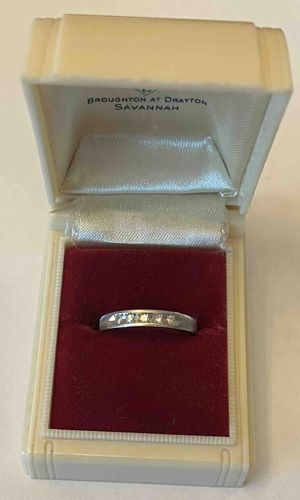
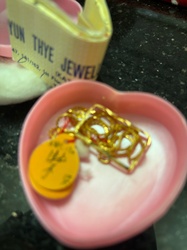
The item is a women's half-eternity band ring, crafted from what appears to be white gold or platinum, as indicated by its silver-tone metallic luster. Given the '14k' context provided, it is most likely 14 karat white gold. The band is relatively thin and has a smooth, polished finish, showing some minor surface wear consistent with light use, such as faint scratches or scuffs, but no significant damage like dents or deformations are visible. It features a channel setting that securely holds approximately five to seven small, round, brilliant-cut diamonds, evenly spaced across the visible face of the ring. The diamonds appear to be of similar size and quality, with good clarity and sparkle, although their exact carat weight and color grade cannot be determined from the image alone. The setting ensures the stones are flush with the band, creating a continuous, elegant line. The ring is presented in a vintage-style jewelry box, possibly made of Bakelite or a similar early plastic, with an ivory or cream color. The interior of the box features a red velvet-like lining for the ring bed and white satin or silk in the lid, printed with the text "BROUGHTON AT DRAYTON SAVANNAH", which likely indicates the jeweler or the location of purchase. The design of the box suggests an age from the mid-20th century, possibly 1940s-1960s, which could also hint at the ring's approximate age and style period. The overall craftsmanship of the ring appears to be good, with a well-executed setting and a classic, timeless design.
AI Appraisal Report
Based on my visual examination of the provided image and the owner's confirmation of '14k', I am appraising this 14k White Gold and Diamond Half-Eternity Band Ring. The ring appears to be in good overall condition, exhibiting minor surface wear consistent with light use, such as faint scratches, but no significant damage. The channel-set diamonds, estimated at five to seven small, round brilliant cuts, show good clarity and sparkle, contributing to a continuous, elegant aesthetic. The '14k' designation confirms the white gold content, which is a common and desirable fineness for jewelry. The vintage presentation box, likely from the mid-20th century, suggests a potential corresponding age for the ring, indicating a classic and timeless design.
In terms of market conditions, half-eternity bands are consistently popular due to their versatility and wearability. Demand for 14k white gold diamond jewelry remains stable, particularly for classic designs like this. The diamonds, while small, contribute value through their quantity and presumed quality. Rarity isn't a significant factor here; similar new and estate pieces are readily available. Key value drivers are the 14k white gold content, the presence and quality of the diamonds, and the ring's good condition.
It is crucial to note the limitations of this appraisal. Authenticity of the gold content ('14k') and the natural origin and precise quality of the diamonds cannot be definitively verified from images alone. A physical examination by a gemologist is essential for accurate diamond grading (carat weight, color, clarity, cut), confirmation of natural origin, and verification of metal purity through testing. Documentation of provenance, such as original purchase receipts or diamond certificates, would further enhance authentication and value. Without these, the appraisal relies on visual assumptions.