These notes were written by the person who submitted this item. Appraiser.AI has not verified them, and the AI's identification and estimate may rely on them.
AI Estimated Value
Not an official valuation
$300 - $500
AI estimate as of July 23, 2025 · verify with a professional before acting
AI-Generated · Verify before acting
Everything on this page is generated by AI for informational purposes only. AI can make mistakes — the AI may misidentify items or misattribute them (artist, maker, brand, designer, origin, era). This is not an official valuation and should not be used for insurance, sale, tax, estate, legal, or lending purposes — or any decision requiring a certified appraisal. It is not an authoritative claim about any person, brand, or rights holder — do not share or rely on it as a factual statement about a third party. Always consult qualified professionals before making financial decisions.
This analysis also relies on unverified notes provided by the user, which may be incomplete or inaccurate and could affect the result.
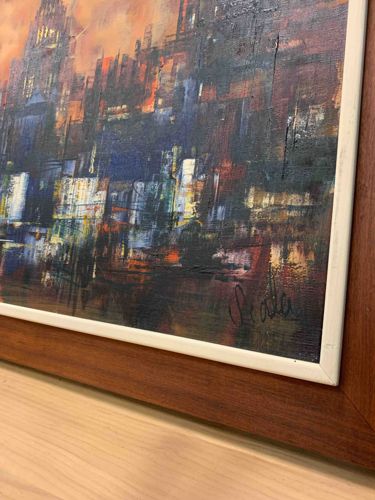
This item is an original oil painting depicting a vibrant, abstract cityscape at what appears to be dusk or night, characterized by a dynamic interplay of light and shadow. The painting utilizes a rich palette, with dominant hues of deep blues, black, and grays forming the base architecture and water reflections, contrasted with striking pops of bright orange, red, yellow, and white representing illuminated windows, streetlights, or reflections on wet surfaces. The brushwork is expressive and impasto, creating significant texture and depth, particularly visible in the application of thick paint that gives the impression of light sources and their blurred reflections. The composition features tall, silhouetted structures against an orange-toned sky at the top, transitioning down into a more fragmented and reflective lower half, suggesting a body of water or wet ground mirroring the city lights. While specific dimensions are not provided, it appears to be a medium to large-sized piece, framed in a multi-part wooden frame. The frame consists of a wider, reddish-brown outer section with visible wood grain, and a narrower, lighter, possibly off-white or cream-colored inner liner that directly abuts the canvas. There are no immediate signs of significant damage to the canvas, such as tears or large areas of paint loss, though minor scuffs or dust accumulation might be present on the frame. The visible signature on the lower right corner, though partially obscured and somewhat illegible, appears to be 'Scada', 'Seada', or similar, indicating the artist's name. The overall style suggests a mid-20th century to late 20th century creation, possibly influenced by Expressionism or Abstract Impressionism, emphasizing mood and color over precise representation. The craftsmanship appears competent, with a clear artistic vision and confident application of paint.
AI Appraisal Report
Upon examination of the provided image, I have assessed this original oil on canvas, an abstract cityscape signed 'Scada' or a similar name. The piece exhibits a dynamic composition with a vibrant, contrasting color palette and heavy impasto technique, characteristic of mid-to-late 20th-century expressionism. The brushwork is confident, and the overall aesthetic is visually compelling. The painting appears to be in good condition with no visible tears or significant paint loss. The multi-part wooden frame is intact, though it may have minor age-related wear.
The market for decorative, abstract works by unlisted or regional artists is steady. The value is primarily derived from its decorative appeal, skilled execution, and size, rather than the artist's name, as 'Scada' does not correspond to a major, well-documented artist in my databases. Comparable works by other competent but unlisted artists of this style and period typically sell in the low to mid-hundreds at auction and in galleries.
A significant limitation of this appraisal is the inability to authenticate the work definitively from images alone. The signature is unclear, and without a known artist history, its origin is uncertain. For a full authentication, an in-person examination would be required to assess the canvas age, paint composition, and any markings on the reverse. Furthermore, any provenance documentation, such as receipts or exhibition history, would be crucial in establishing a more concrete valuation and history for the piece.