AI estimate as of October 3, 2025 · verify with a professional before acting
AI-Generated · Verify before acting
Everything on this page is generated by AI for informational purposes only. AI can make mistakes — the AI may misidentify items or misattribute them (artist, maker, brand, designer, origin, era). This is not an official valuation and should not be used for insurance, sale, tax, estate, legal, or lending purposes — or any decision requiring a certified appraisal. It is not an authoritative claim about any person, brand, or rights holder — do not share or rely on it as a factual statement about a third party. Always consult qualified professionals before making financial decisions.
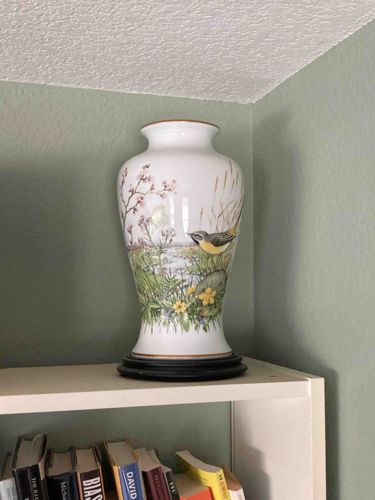
This is a porcelain vase, likely ceramic, featuring a hand-painted or decal-applied wildlife scene. The vase has a classic, slightly flared neck, a bulbous body that tapers towards the base, and a gently rounded foot. Its primary color is a glossy white, providing a bright canvas for the decorative motif. The rim of the vase and a subtle band near the base are adorned with a thin gold-colored line, suggesting a decorative trim detail. The central decoration depicts a naturalistic outdoor scene with a small bird, possibly a 'Wagtail' or similar species with a yellow breast and gray back, perched on what appears to be a stone or small mound next to a body of water. Surrounding the bird and water are lush green grasses, delicate yellow wildflowers, and taller, dried reeds or wheat stalks. On the opposite side, or possibly wrapping around, there are branches with small pinkish-white blossoms, typical of a spring or early summer scene. The overall style suggests a decorative, possibly collectible, piece from the mid-20th century onwards, often found in 'cottagecore' or traditional home decor. The craftsmanship appears to be of good quality, with clear detailing in the artwork. No obvious chips, cracks, or repairs are visible from the provided image, but a thorough inspection would be required to confirm its pristine condition. The vase rests on a separate, flat, circular black wooden or plastic base, which elevates it slightly and provides stability. This base seems to be a common accessory for decorative vases, giving them a more finished look.
AI Appraisal Report
Based on my visual examination of the provided image, this porcelain vase with a wildlife motif appears to be in very good to excellent condition. I observe no obvious chips, cracks, or repairs on the vase or its decorative elements, suggesting it has been well-preserved. The artwork, a charming hand-painted or decal-applied scene featuring a bird, wildflowers, and reeds, is well-detailed and vibrant. The gold-colored trim accents the classic form effectively. The separate black base is a common accessory, adding to its display appeal.
From a market perspective, this piece falls into the decorative arts category, appealing to those who favor traditional or 'cottagecore' aesthetics. While the craftsmanship appears good, it lacks distinct maker's marks or a known provenance that would elevate its value significantly. Similar decorative porcelain vases from the mid-20th century to contemporary periods, often unsigned or from less prominent manufacturers, typically sell within a modest range. Demand for such items is consistent but not high-ticket, usually driven by aesthetic appeal rather than rarity or historical significance. Factors impacting value include the general absence of unique artistic signature, limited historical context without provenance, and the likelihood of mass production techniques rather than bespoke craftsmanship.
Critically, a definitive assessment of authenticity regarding the painting technique (hand-painted vs. decal) and the manufacturer cannot be made from images alone. An in-person examination would be essential to inspect for artist signatures, maker's marks, and to differentiate between hand-painting and decal application through tactile inspection and magnified viewing. Without such an examination or documented provenance, I cannot confirm its exact origin or whether it possesses any specific collector's value beyond its decorative appeal.