AI estimate as of September 14, 2025 · verify with a professional before acting
AI-Generated · Verify before acting
Everything on this page is generated by AI for informational purposes only. AI can make mistakes — the AI may misidentify items or misattribute them (artist, maker, brand, designer, origin, era). This is not an official valuation and should not be used for insurance, sale, tax, estate, legal, or lending purposes — or any decision requiring a certified appraisal. It is not an authoritative claim about any person, brand, or rights holder — do not share or rely on it as a factual statement about a third party. Always consult qualified professionals before making financial decisions.
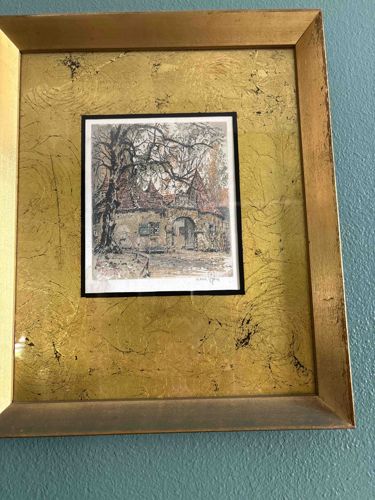
This item is a framed and hand-colored etching depicting a picturesque European townscape, likely a village or a section of an older town. The central image, an etching, portrays architectural elements like a building with a distintive tile roof, possibly a gatehouse or an entrance, and is overshadowed by a large, mature tree with intricate, bare branches, suggesting an autumn or winter scene. The etching itself is rendered in fine lines, characteristic of the medium, with subtle hand-coloring applied, particularly visible in the reddish-brown tones of the roof and hints of green or earthy tones in the foliage areas. The artwork is set within a black mat, which contrasts sharply with the white border of the etching, drawing attention to the central image. This mat is then surrounded by a wider, secondary mat or liner that features a textured, gold-leaf-like finish with visible black brushstrokes or intentional distressing, creating an antique or marbled effect. The entire presentation is encased in a multi-toned, possibly wooden, picture frame. The frame has an inner gold-toned lip that directly abuts the gold-textured mat, and an outer, wider section that appears to be a brushed gold or bronze color with a slightly distressed or aged finish. The corners of the frame show neat mitered joints. The construction suggests a traditional framing approach aimed at enhancing the artistic content. While specific artist details are not discernible from the image, the style hints at an early to mid-20th-century European aesthetic. The overall condition appears good, with no obvious signs of significant damage to the frame or the artwork, although minor wear consistent with age might be present upon closer inspection.
AI Appraisal Report
This framed hand-colored etching presents as a charming European townscape, likely from the early to mid-20th century. Based on visual examination, the artwork appears to be in good condition. The etching itself shows fine line work characteristic of the medium, with subtle, well-preserved hand-coloring. The framing, including the black mat, gold-textured liner, and multi-toned distressed gold frame, complements the artwork effectively and appears structurally sound with neat mitered joints.
Authenticity of the print and coloring can be inferred from the visual characteristics typical of hand-colored etchings from that period. However, without in-person inspection, I cannot verify the type of paper, the exact coloring medium, or if the coloring is original to the print.
Market conditions for unsigned, decorative hand-colored etchings of this nature are stable but not high-demand. Comparables typically sell in the $100-$300 range, depending on subject matter, condition, and quality of framing. This piece's attractive composition and good presentation contribute positively to its value. Demand is generally from collectors seeking decorative art for home or office. Rarity is not a significant factor as similar prints were produced in some quantity.
Factors impacting value include the lack of a discernible artist's signature or edition number, which prevents identification of a known printmaker and limits potential for higher value. The quality of the hand-coloring is good, enhancing its decorative appeal.
Limitations in authenticity verification are inherent to image-based appraisal. A physical examination would allow me to assess paper quality, watermarks, plate marks, and the precise technique of hand-coloring, which could confirm origin and age more definitively. Provenance documentation, if available, would significantly enhance authenticity and value, particularly if linked to a recognized artist or studio. Scientific testing is generally not applied to pieces of this nature unless specific concerns about forgery arise.