AI Appraisal Estimate

AI-generated estimates · not official valuations

From the user

What was submitted

Photo and notes provided by the user — not generated by AI

Submitted item photo
Submitted photo · May 27, 2026

User's notes

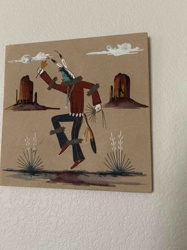
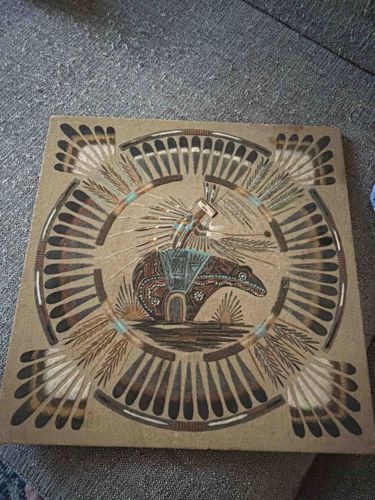
Navajo sand painting

AI analysis below

AI appraisal

AI analysis & estimate

AI-Generated · Verify before acting

Everything below is generated by AI for informational purposes only. AI can make mistakes — the AI may misidentify items or misattribute them (artist, maker, brand, designer, origin, era). This is not an official valuation and should not be used for insurance, sale, tax, estate, legal, or lending purposes — or any decision requiring a certified appraisal. It is not an authoritative claim about any person, brand, or rights holder — do not share or rely on it as a factual statement about a third party. Always consult qualified professionals before making financial decisions.

Note

This analysis also relies on unverified notes provided by the user, which may be incomplete or inaccurate and could affect the result.

Read the full disclaimer

AI Identification

·Not independently authenticated·Verify before acting

Navajo Sand Painting of a Sacred Bear and Medicine Man

Native American Folk Art

AI Estimated Value

·Not an official valuation·Verify before acting

$450 - $650

As of May 27, 2026

AI Item Analysis

·AI can make mistakes·Verify before acting
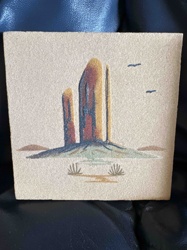
This is a contemporary Navajo sand painting, or 'dry painting,' executed on a square particle board or plywood base. The artwork features a central motif of a ceremonial bear, a powerful symbol in Navajo culture representing protection and healing, surmounted by a stylized Medicine Man or deity figure. The composition is highly symmetrical, enclosed within a circular border of decorative motifs and eagle feather fans at the four cardinal directions. The palette is composed of natural earth tones, including tan, ochre, terracotta, dark brown, and white, with striking accents of turquoise blue sand. The medium consists of finely ground colorful minerals and sands meticulously adhered to the surface with a hidden binding agent. The linework is exceptionally fine, showcasing high-level craftsmanship in the rendering of individual feather barbs and geometric patterns on the bear's flank. The condition appears to be excellent for its age, with no visible loss of sand or significant chips to the edges of the board. There is a slight patina of dust consistent with display over time. Based on the style and materials, this piece likely dates from the late 20th century (circa 1970-1990), a period when Navajo artists began creating permanent versions of traditional ephemeral ceremonial paintings for the commercial art market.
AI Appraisal Report

·AI can make mistakes·Verify before acting
Based on my examination of this contemporary Navajo sand painting, I find it to be a high-quality example of the permanent 'dry painting' technique developed for the commercial market in the late 20th century. My visual assessment confirms the use of natural mineral sands, with the turquoise accents and fine linework on the eagle feathers indicating a skilled hand. The symmetrical composition featuring the Sacred Bear and Medicine Man is culturally significant, appealing to collectors of Southwest Native American art. The condition is excellent; I observe no significant 'bleeding' of dyes or loss of grit, which often plagues lesser examples. In the current market, mid-sized sand paintings of this complexity typically realize between $400 and $700 at regional galleries or specialized auctions. The value is bolstered by the density of the pattern, though the lack of a visible artist signature on the front—common but impactful—places it in the mid-range of pricing. Critically, my appraisal is based on photographic evidence. I cannot definitively verify the binding agent's stability or the presence of a signature on the verso without physical inspection. For a full authentication of the artist and tribal provenance, I would require a viewing of the back of the board for signatures or gallery labels, and documentation of the piece's acquisition history. Nevertheless, as a decorative and representative piece of Navajo folk art, it remains a desirable specimen.

Get your items appraised

Instant estimates of your treasures with AI-powered appraisals

Browse More Appraisals