AI estimate as of July 4, 2025 · verify with a professional before acting
AI-Generated · Verify before acting
Everything on this page is generated by AI for informational purposes only. AI can make mistakes — the AI may misidentify items or misattribute them (artist, maker, brand, designer, origin, era). This is not an official valuation and should not be used for insurance, sale, tax, estate, legal, or lending purposes — or any decision requiring a certified appraisal. It is not an authoritative claim about any person, brand, or rights holder — do not share or rely on it as a factual statement about a third party. Always consult qualified professionals before making financial decisions.
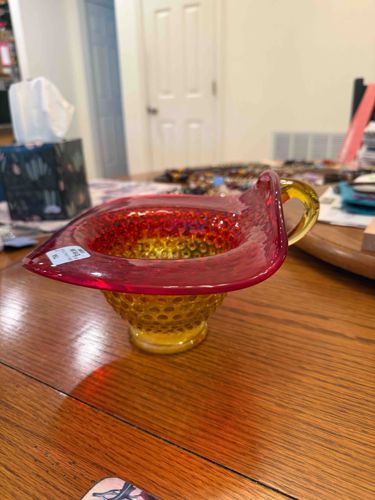
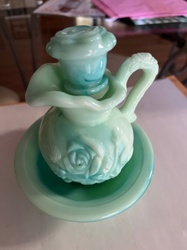
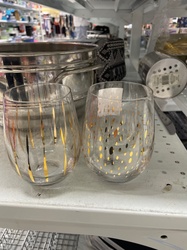
The item is a small, possibly mid-century art glass creamer or sugar bowl, exhibiting a vibrant color transition from a rich ruby red at the rim to a translucent golden yellow in the hobnail-textured body. Its physical characteristics include a wide, undulating rim with a smooth finish, tapering down to a bulbous body adorned with an all-over hobnail pattern, creating a tactile and visually interesting surface. The base appears to be a solid, short pedestal foot. A single, gracefully curved handle, made of clear or slightly yellowish glass, is attached to one side, complementing the body's color scheme. The approximate size appears to be suitable for a small serving of cream or sugar, likely standing around 4-6 inches tall. There are no immediately discernible condition issues such as chips or cracks visible in the provided image; the glass appears to be in good, used condition with a gentle patina consistent with its likely age. No specific maker's marks or signatures are visible, although a white sticker, possibly a price tag or inventory label, is affixed to the exterior near the rim. The craftsmanship suggests a blown or pressed glass manufacturing process, with the hobnail pattern indicating a mold. The graduated coloring suggests an 'ombré' or 'fade' technique, a common feature in art glass from the mid-20th century. Its unique combination of color, texture, and elegant form makes it a distinctive piece of decorative glassware.
AI Appraisal Report
Upon examining the provided image of the Ruby Red to Golden Yellow Hobnail Art Glass Creamer/Sugar, I assess its condition as good, suggesting gentle use consistent with its likely age. There are no readily apparent chips, cracks, or significant abrasions visible; the glass appears intact and vibrant. The gentle patina is indicative of age rather than damage.
From a market perspective, gradient colored hobnail glass, particularly with such a striking color transition, typically garners moderate interest among collectors of mid-century art glass. While specific maker's marks are absent and cannot be verified from the image, such pieces are often attributed to Murano, Bohemian, or American glassworks of the mid-20th century. Authenticity concerning a specific maker cannot be definitively confirmed without physical examination for pontil marks, manufacturing characteristics, or more. The presence of a white sticker suggests a previous retail or inventory context, but offers no direct authentication.
Demand for decorative glassware of this type is steady, driven by its aesthetic appeal and the trend towards vintage home decor. Rarity is moderate; while hobnail glass is common, this specific color combination and form makes it somewhat less common than single-colored or mass-produced items. Factors significantly impacting value include the striking color fade, the tactile hobnail texture, and the overall charming design. The absence of a definitive maker marks, however, limits its maximum potential value.
To fully authenticate and maximize value, an in-person examination is crucial. This would allow for a detailed inspection for a pontil mark (indicating hand-blown vs. machine-pressed), evaluation of the glass quality and weight, and microscopic analysis for any subtle condition issues. Provenance documentation, such as original sales receipts or family history, would also significantly aid in authentication and valuation. Spectroscopic analysis could potentially determine the glass composition, offering clues about its origin, but this is typically reserved for higher-value pieces.