AI estimate as of August 9, 2025 · verify with a professional before acting
AI-Generated · Verify before acting
Everything on this page is generated by AI for informational purposes only. AI can make mistakes — the AI may misidentify items or misattribute them (artist, maker, brand, designer, origin, era). This is not an official valuation and should not be used for insurance, sale, tax, estate, legal, or lending purposes — or any decision requiring a certified appraisal. It is not an authoritative claim about any person, brand, or rights holder — do not share or rely on it as a factual statement about a third party. Always consult qualified professionals before making financial decisions.
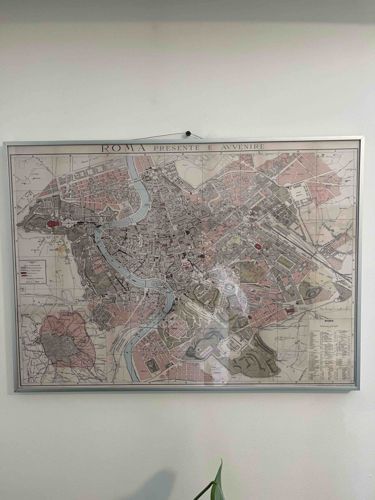
The item is a framed historical map of Rome, titled "ROMA PRESENTE E AVVENIRE" (Rome Present and Future). The map is rectangular and appears to be of standard poster size, likely printed on paper. It depicts the city of Rome with a high level of detail, showing street layouts, buildings, green spaces, and the Tiber River, which is prominently rendered in a light blue hue. Different areas or features of the city are highlighted with various colors, predominantly shades of pinkish-red for urban areas and light green/brown for open spaces, characteristic of cartography from the late 19th or early 20th century. The map has a historical aesthetic, indicative of an older production. It is housed within a simple, light-colored, possibly silver-toned or brushed aluminum, metal frame. The frame has a slim profile, consistent with modern framing styles, suggesting that the map itself might be a reproduction or an original antique piece that has been recently framed for display. There are no obvious signs of significant damage to the map itself visible through the frame, although direct inspection for creases, tears, or fading is impossible from the image. The glass or acrylic covering the map appears clear but shows some reflections, typical of framed items. The overall condition appears good for display, with the framing protecting the print. The crafting of the map itself indicates attention to detail, common in historical cartography, likely mass-produced for educational or decorative purposes.
AI Appraisal Report
Based on my visual examination of the provided image, I appraise this Framed 'ROMA PRESENTE E AVVENIRE' Map. The map itself appears to be a historical print, likely from the late 19th or early 20th century, given its cartographic style, coloring, and title. The prominent light blue depiction of the Tiber River and the detailed urban planning suggest a high level of craftsmanship. The framing, a simple, slim-profile metal frame, seems contemporary, indicating either a recent re-framing of an original piece or the framing of a reproduction. I note no obvious signs of significant damage to the map, such as tears, folds, or severe discoloration, from the image. The glass/acrylic covering is clear, albeit with reflections.
From a market perspective, historical maps of major European cities, especially Rome, maintain a consistent demand. Originals from this period can fetch significant prices, particularly if they are rare editions or feature unique cartographic details. Demand is driven by collectors of antique maps, history enthusiasts, and interior designers seeking sophisticated decorative pieces. Comparables for original historical maps of Rome range widely, from a few hundred dollars for common prints to several thousands for rare or significant editions. Reproductions, while visually appealing, command considerably less.
Key value impact factors include authenticity, condition, and rarity. Without physical inspection, I cannot confirm if this is an original print or a high-quality reproduction. The modern framing could suggest either scenario. Limitations in authenticity verification from images alone are significant; I cannot assess paper type, printing technique, or microscopic details that would confirm age and originality. For full authentication, an in-person examination to assess paper texture, watermarks, printing method (e.g., lithography vs. modern digital print), and the presence of any expert-identifiable hallmarks is necessary. Provenance documentation, if available, would also be crucial. Scientific testing, such as carbon dating or ink analysis, would be the definitive step for absolute authentication but is typically reserved for much higher-value items.