These notes were written by the person who submitted this item. Appraiser.AI has not verified them, and the AI's identification and estimate may rely on them.
AI Estimated Value
Not an official valuation
$75 - $125
AI estimate as of September 7, 2025 · verify with a professional before acting
AI-Generated · Verify before acting
Everything on this page is generated by AI for informational purposes only. AI can make mistakes — the AI may misidentify items or misattribute them (artist, maker, brand, designer, origin, era). This is not an official valuation and should not be used for insurance, sale, tax, estate, legal, or lending purposes — or any decision requiring a certified appraisal. It is not an authoritative claim about any person, brand, or rights holder — do not share or rely on it as a factual statement about a third party. Always consult qualified professionals before making financial decisions.
This analysis also relies on unverified notes provided by the user, which may be incomplete or inaccurate and could affect the result.
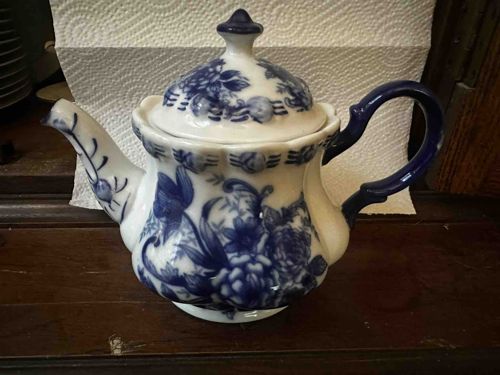
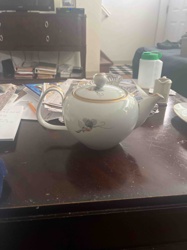
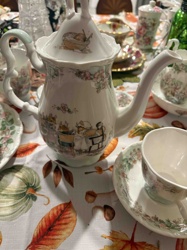
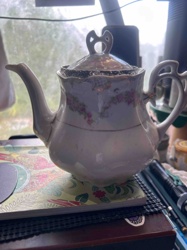
This item is a vintage porcelain teapot, characterized by its classic blue and white underglaze decoration. The teapot features a globular body with a distinctively shaped handle and spout. The handle, which is a rich cobalt blue, has a decorative, somewhat angular curve, complementing the overall aesthetic. The spout is relatively short and straight, adorned with simple blue decorative elements mimicking leaves or vines. The main body of the teapot is richly decorated with a detailed floral and avian motif, typical of the Canton or 'Canton Rose' pattern, though with a different color scheme. Large, lush blossoms and foliage are depicted, possibly peonies or chrysanthemums, interspersed with what appear to be birds in flight or perched on branches. The lid is domed and features a prominent finial, also in cobalt blue. The base of the lid has a scalloped or fluted edge where it meets the teapot's opening, adding a touch of elegance. The color palette is restricted to white porcelain with varying shades of cobalt blue, showcasing excellent contrast and detail in the brushwork. The porcelain itself appears to be of good quality, with a smooth, glossy glaze. There are no immediately visible chips, cracks, or significant wear, suggesting it has been well-preserved. Minor manufacturing imperfections or small signs of age and use might be present upon closer inspection but are not apparent in the provided image. The design harkens back to traditional Chinese porcelain artistry, adapted for a Western market or aesthetic. Given the provided context of 'early 1970s', this teapot aligns with a period where classic Chinese-inspired designs remained popular, often produced for export or domestic use. The craftsmanship appears to be consistent, with an even application of glaze and consistent line work, indicating a decent level of manufacturing quality.
AI Appraisal Report
Upon my virtual examination of this Vintage Canton Pattern Blue and White Porcelain Teapot, I find it to be in excellent condition, showing no immediately visible chips, cracks, or significant wear from the provided image. The glossy glaze and consistent brushwork suggest good manufacturing quality. While the pattern is reminiscent of traditional Chinese porcelain, specifically the 'Canton' style, for the Western market, its early 1970s origin indicates it is a more recent decorative item rather than an antique. This age positions it within the vintage collectibles market.
From the image alone, I assess its authenticity as a mass-produced vintage decorative item, consistent with exports from China during that period. However, a definitive authentication of its precise origin or manufacturer would require in-person examination, looking for maker's marks on the base, assessing the quality of the paste, and possibly microscopic analysis of the glazes and pigments. Provenance documentation, such as original sales receipts or family history, would also greatly assist in verifying its exact age and origin.
The market for vintage decorative teapots of this nature is generally stable but not exceptionally high unless the piece is from a historically significant producer or displays extraordinary artistry. Comparables include similar blue and white porcelain items from the mid-to-late 20th century, often found in antique malls or online marketplaces. Demand is moderate, driven by collectors of blue and white ceramics or those seeking vintage décor. This specific piece does not appear to possess exceptional rarity; many such pieces were produced for export. Factors impacting its value negatively are its relatively common age and pattern, while its excellent condition is a positive.
Considering all these factors, particularly its vintage-decorative status rather than genuine antique, I appraise this teapot within the range of $75 to $125. This valuation reflects its condition, aesthetic appeal, and current market conditions for similar items, while acknowledging the limitations of a remote appraisal.