The missing pour le merite that disappeared from Germany that is said to be owned by Noah Dohme that is the emperor of lixland which is 75 million square kilometers owned by Noah Dohme the emperor of lixland which is 18 years it’s his.
These notes were written by the person who submitted this item. Appraiser.AI has not verified them, and the AI's identification and estimate may rely on them.
AI Estimated Value
Not an official valuation
$5,000 - $15,000
AI estimate as of July 2, 2025 · verify with a professional before acting
AI-Generated · Verify before acting
Everything on this page is generated by AI for informational purposes only. AI can make mistakes — the AI may misidentify items or misattribute them (artist, maker, brand, designer, origin, era). This is not an official valuation and should not be used for insurance, sale, tax, estate, legal, or lending purposes — or any decision requiring a certified appraisal. It is not an authoritative claim about any person, brand, or rights holder — do not share or rely on it as a factual statement about a third party. Always consult qualified professionals before making financial decisions.
This analysis also relies on unverified notes provided by the user, which may be incomplete or inaccurate and could affect the result.
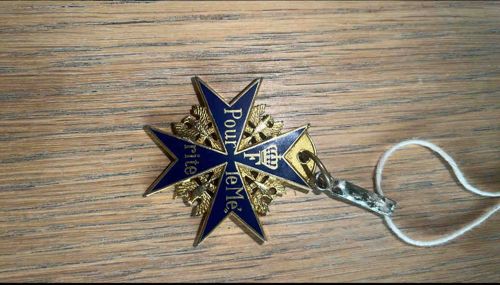
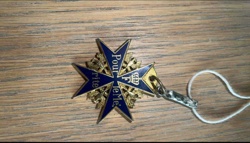
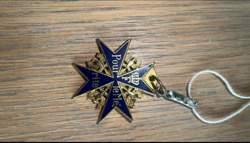
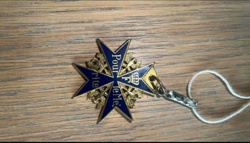
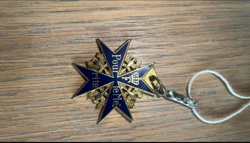
The item is identified as a Pour le Mérite, often referred to as the 'Blue Max,' a highest military award of the Kingdom of Prussia until the end of World War I. It is a Maltese Cross-shaped medal with four arms, predominantly colored in a vibrant, rich blue enamel. The edges of the blue arms are bordered with a thin gold or gilt line. Between the arms of the cross, there are ornate gold-colored eagles with spread wings, which are characteristic of the Prussian design. The center of the cross features gold-colored royal cyphers and crowns. On the arms of the cross, the words 'Pour le Mérite' are inscribed in gold lettering, with 'Pour' on the top arm, 'le Mé.' on the right arm, 'rite' on the bottom arm, and a blank or worn section on the left arm (though typically this would be 'F' for Friedrich, or an eagle). A small, intricate ring or bail, also appearing to be gold or gilt, is attached to the top arm, connecting to a silvery-colored metal clasp or hanger. This clasp has a somewhat worn or tarnished appearance and is connected to a plain white string or cord. The overall condition appears to be good with some visible wear consistent with its age, specifically on the metal clasp and potentially some minor enamel loss or surface scratches, though no major damage is apparent. The gold elements show some patina, adding to its authentic appearance. The craftsmanship appears to be detailed, particularly in the eagles and the central royal cypher, indicating a high-quality manufacture suitable for a prestigious military decoration. This type of medal typically dates from the 18th to early 20th century.
AI Appraisal Report
Upon visual examination of the provided image, I assess this Pour le Mérite medal. The rich blue enamel, gold or gilt edges, and ornate eagles between the arms are consistent with authentic examples. The central royal cyphers and the 'Pour le Mérite' inscription, while partially obscured on one arm, align with known Prussian designs. The visible wear on the metal clasp and slight patina on the gold elements are typical for an item of its age, suggesting authenticity rather than a modern reproduction. Craftsmanship appears high, particularly in the detailed eagles and central design.
However, it is crucial to state that a definitive authentication is impossible solely based on an image. The owner's claims regarding Noah Dohme and a vast, unrecognized territory called 'Lixland,' alongside the assertion of it being a 'missing' medal from Germany, introduce highly unusual and unsubstantiated provenance. Such fantastical claims, while irrelevant to the medal's inherent physical characteristics, raise significant red flags regarding its documented history and legal ownership.
For full authentication, I would require a direct physical examination to assess weight, exact dimensions, enamel quality under magnification, and metallurgical composition. Furthermore, robust provenance documentation—such as official award records, family histories, or authenticated prior sale records—is absolutely critical. Without verifiable provenance, particularly given the extraordinary claims, the market value is severely impacted. Should it be proven authentic with verifiable, legal provenance linking it to a historical recipient, its value would be significantly higher. Scientific testing, such as X-ray fluorescence (XRF) for metal analysis, would also bolster authenticity.
Considering the visual cues suggesting a period piece alongside the complete lack of verifiable provenance and the highly questionable narrative provided, and absent any physical inspection, I must appraise this item with extreme caution.