AI Appraisal Estimate

AI-generated estimates · not official valuations

From the user

What was submitted

Photo and notes provided by the user — not generated by AI

Submitted item photo
Submitted photo · June 10, 2026

User's notes

Kusak Seattle

AI analysis below

AI appraisal

AI analysis & estimate

AI-Generated · Verify before acting

Everything below is generated by AI for informational purposes only. AI can make mistakes — the AI may misidentify items or misattribute them (artist, maker, brand, designer, origin, era). This is not an official valuation and should not be used for insurance, sale, tax, estate, legal, or lending purposes — or any decision requiring a certified appraisal. It is not an authoritative claim about any person, brand, or rights holder — do not share or rely on it as a factual statement about a third party. Always consult qualified professionals before making financial decisions.

Note

This analysis also relies on unverified notes provided by the user, which may be incomplete or inaccurate and could affect the result.

Read the full disclaimer

AI Identification

·Not independently authenticated·Verify before acting

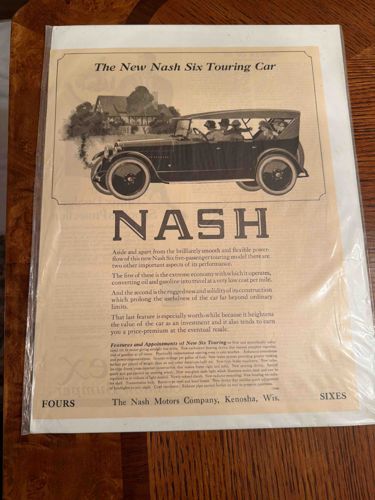
Vintage 1920s Nash Motors Company Magazine Advertisement

Automobilia & Vintage Advertising Prints

AI Estimated Value

·Not an official valuation·Verify before acting

$15 - $30

As of June 10, 2026

AI Item Analysis

·AI can make mistakes·Verify before acting
This is an original print advertisement for 'The New Nash Six Touring Car' from the Nash Motors Company of Kenosha, Wisconsin, likely dating from the early-to-mid 1920s. The piece features a prominent monochromatic illustration of the five-passenger touring model filled with passengers, set against a backdrop of a residential structure. The layout includes the bold 'NASH' typography in a block-lettering style characteristic of the era's corporate branding. Below the image, the copy highlights the vehicle's economy of operation and rugged construction. The advertisement is printed on newsprint-style paper which shows significant age-related toning and yellowing (patina) throughout, consistent with its century-old manufacture. It is currently housed in a protective clear plastic sleeve with a white cardboard backing. The paper appears relatively well-preserved for its age, with sharp edges and no immediately visible tears or significant creases, though there is a slight transparency to the paper. The bottom margin includes references to the 'FOURS' and 'SIXES' model lines. This piece represents a high-quality example of early automotive marketing and graphic design during the boom of the American motor industry.
AI Appraisal Report

·AI can make mistakes·Verify before acting
Based on my visual examination of this vintage Nash Motors Company advertisement, I am evaluating it as an original print extracted from a periodical, likely dating to circa 1924-1926. The piece features the notable 'New Nash Six Touring Car' illustration, a classic example of 1920s automotive line art. The condition appears to be Very Good for ephemera of this vintage. The paper exhibits uniform age-toning and yellowing, which is expected for century-old newsprint-stock paper and adds to the authentic aesthetic. Vital to value, the edges remain sharp and I observe no significant foxing, water stains, or tears, which often plague loose magazine pages. The typography remains crisp. However, without physical inspection, I cannot confirm the paper weight or check for archival acid damage hidden by the backing board. The market for single-page automotive advertisements is active but saturated. While Nash is a respected defunct marque, it does not command the premium of luxury brands like Duesenberg or Packard. Comparable advertisements from general interest magazines (like The Saturday Evening Post or Literary Digest) typically sell in the $15-$25 range retail, often predicated on the quality of the matting or framing, which is absent here. Authenticity appears highly probable given the printing style and paper texture visible in the image, but definitive verification would require a loupe examination of the dot pattern (halftone) to rule out a modern reproduction. To achieve a higher valuation, this piece would need to be part of a complete, unseparated periodical or possess rare provenance linking it to a specific dealership history, neither of which is present.

Get your items appraised

Instant estimates of your treasures with AI-powered appraisals

Browse More Appraisals