These notes were written by the person who submitted this item. Appraiser.AI has not verified them, and the AI's identification and estimate may rely on them.
AI Estimated Value
Not an official valuation
$1,500-2,500
AI estimate as of December 12, 2025 · verify with a professional before acting
AI-Generated · Verify before acting
Everything on this page is generated by AI for informational purposes only. AI can make mistakes — the AI may misidentify items or misattribute them (artist, maker, brand, designer, origin, era). This is not an official valuation and should not be used for insurance, sale, tax, estate, legal, or lending purposes — or any decision requiring a certified appraisal. It is not an authoritative claim about any person, brand, or rights holder — do not share or rely on it as a factual statement about a third party. Always consult qualified professionals before making financial decisions.
This analysis also relies on unverified notes provided by the user, which may be incomplete or inaccurate and could affect the result.
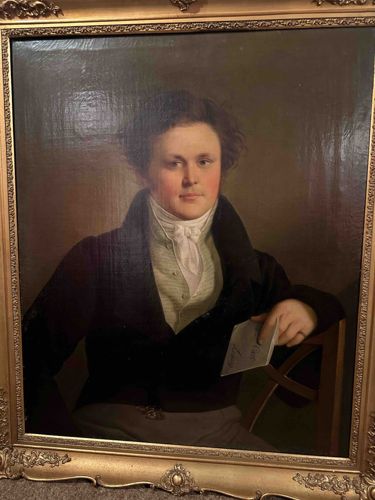
This is an oil painting on cardboard depicting a portrait of a gentleman, likely dating to the early to mid-19th century, given the stylistic cues and the 'older than 120 years' context. The subject is a relatively young man with a ruddy complexion, dark, curly hair, and a somewhat full face, gazing directly at the viewer with a neutral expression. He is dressed in attire characteristic of the period, featuring a dark, perhaps navy or black, knee-length coat or frock coat with wide lapels and a high collar. Beneath this, he wears a light-colored vest, possibly pale green, and a crisply tied white cravat or stock, indicating a degree of formality. The background is a muted, dark greenish-brown, providing a stark contrast that highlights the figure. The gentleman is seated, with portions of a wooden chair visible, and holds a small, folded piece of paper or letter in his left hand, suggesting a personal message or perhaps a business document. This detail adds a narrative element to the portrait. The brushwork appears somewhat loose yet provides good definition to the features and clothing. Visible condition issues include some surface dirt, minor abrasions, and a faint craquelure typical of oil paintings of this age. The painting is housed within a substantial, ornate gilded frame with rococo-style scrolling and decorative elements, which itself shows signs of age such as minor chips and discoloration. The overall craftsmanship of both the painting and its frame speak to a period of artistic tradition and attention to detail, characteristic of portraiture for the gentry or rising middle class.
AI Appraisal Report
Based on my examination of the provided image and information, this 'Portrait of a Gentleman, Oil on Cardboard' presents as a compelling piece from the early to mid-19th century. The subject's attire, hairstyle, and the overall painting style are consistent with that period, supporting the 'older than 120 years' claim. The condition appears fair for its age, noting visible surface dirt, minor abrasions, and craquelure, which are expected. The ornate gilded frame, though showing wear, complements the painting well and adds to its presentation.
In terms of market conditions, portraits from this era by unknown artists on cardboard can have varying demand. The specific details, such as the gentleman holding a document and the direct gaze, add interest and a narrative quality, which buyers often appreciate. While not rare in the broader sense of 19th-century portraiture, the quality of execution here is above average for an anonymous work. Comparables for similar pieces by unlisted artists typically range from a few hundred to a few thousand dollars, depending heavily on aesthetic appeal and condition.
The artwork's marketability is enhanced by its good composition and what appears to be a relatively well-preserved state, along with the attractive original frame. Factors significantly impacting value include the anonymous artist – attribution to a known painter would dramatically increase value – and the lack of a specific historical sitter. Without provenance documentation, full authentication, particularly artist attribution, remains speculative based solely on images. A physical examination would allow for definitive assessment of the medium's integrity, a thorough condition report, and potential identification of artist signatures or inscriptions not visible. Scientific testing, such as pigment analysis, could further confirm the dating and authenticity.