These notes were written by the person who submitted this item. Appraiser.AI has not verified them, and the AI's identification and estimate may rely on them.
AI Estimated Value
Not an official valuation
$10-25
AI estimate as of July 20, 2025 · verify with a professional before acting
AI-Generated · Verify before acting
Everything on this page is generated by AI for informational purposes only. AI can make mistakes — the AI may misidentify items or misattribute them (artist, maker, brand, designer, origin, era). This is not an official valuation and should not be used for insurance, sale, tax, estate, legal, or lending purposes — or any decision requiring a certified appraisal. It is not an authoritative claim about any person, brand, or rights holder — do not share or rely on it as a factual statement about a third party. Always consult qualified professionals before making financial decisions.
This analysis also relies on unverified notes provided by the user, which may be incomplete or inaccurate and could affect the result.
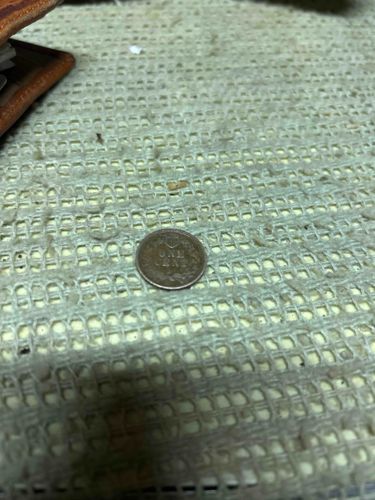
This item is an 1899 United States One Cent coin, commonly known as a 'Lincoln Cent'. Its circular shape and small size are typical for coinage of this denomination. The coin appears to be made of a bronze alloy, displaying the characteristic reddish-brown coloration that develops a darker patina over time, which is evident in the image. Although only the reverse side is clearly visible, the inscription 'ONE CENT' is prominently displayed in the center, encircled by what appears to be a wreath design. The text 'UNITED STATES OF AMERICA' is partially visible along the upper edge of the coin, further confirming its identity. The coin exhibits significant wear, particularly on the raised elements of the design and lettering, suggesting it was extensively circulated. The surface shows a dull, somewhat mottled patina, indicating age and environmental exposure; there are no obvious signs of recent cleaning or polished areas. There are no clear indications of major damage such as bends or deep scratches, but the overall effacement of detail points to its used condition. The quality of craftsmanship, while difficult to ascertain fully from this single view and condition, aligns with standard late 19th-century minting practices for circulating currency. This coin would be classified as an antique due to its age.
AI Appraisal Report
I have examined the provided image of what is described as an 1899 United States One Cent coin, commonly referred to as a 'Lincoln Cent,' though the description contradicts this by dating it to 1899, before the Lincoln Cent's introduction in 1909. Based on the description and the visible reverse, this is consistent with an Indian Head Cent. The inscription 'ONE CENT' within a wreath and 'UNITED STATES OF AMERICA' are clearly visible, confirming its denomination and origin.
From the image, the coin exhibits significant wear, particularly on the higher points of the design and lettering. This suggests a circulated condition, likely in the 'Good' to 'Very Good' range (G-VG) on the Sheldon scale. The surface has a dull, mottled patina, indicating natural aging without signs of recent cleaning, which is a positive factor for collectors. No major damage like bends or deep scratches are apparent, though overall detail is effaced due to wear. The craftsmanship appears consistent with late 19th-century US minting for circulating currency.
Market conditions for common date Indian Head Cents in circulated condition are stable. While not rare, they hold collector interest due to their historical significance. Comparables in similar condition typically trade in the low to mid-double digits. Factors impacting value include the degree of wear, the absence of damage, and original surfaces.
Limitations: My assessment of authenticity is based solely on the provided image and description. Without physical examination, I cannot definitively confirm the coin's authenticity or condition. A full in-person inspection would allow for accurate grading, detection of alterations, and verification of weight, diameter, and strike details. Provenance documentation, while not usually critical for common date Indian Head Cents, could add to certainty. Scientific testing, such as spectroscopy for alloy composition, would be needed for absolute verification, though it's rarely performed on lower-value common coins.