AI estimate as of December 16, 2025 · verify with a professional before acting
AI-Generated · Verify before acting
Everything on this page is generated by AI for informational purposes only. AI can make mistakes — the AI may misidentify items or misattribute them (artist, maker, brand, designer, origin, era). This is not an official valuation and should not be used for insurance, sale, tax, estate, legal, or lending purposes — or any decision requiring a certified appraisal. It is not an authoritative claim about any person, brand, or rights holder — do not share or rely on it as a factual statement about a third party. Always consult qualified professionals before making financial decisions.
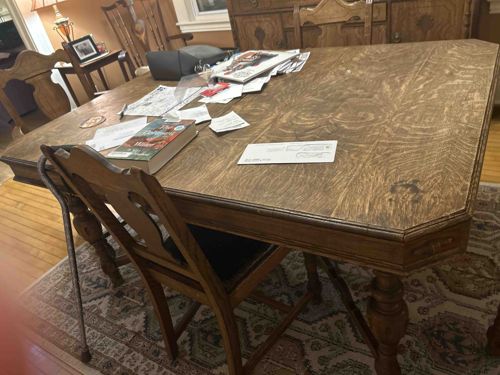
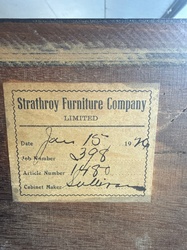
This appears to be an antique dining table, likely constructed from quarter-sawn oak, a popular choice for furniture during the late 19th and early 20th centuries due to its distinctive grain pattern. The tabletop, which is the primary subject in focus, exhibits a rich, medium-brown finish that highlights the characteristic 'snowflake' or 'tiger stripe' figuring of quarter-sawn oak. The table features an octagonal shape on at least one end, suggesting it might be an extension table with leaves that can be inserted, or it could be a fixed octagon-ended table. The edge of the tabletop has a decorative molding or apron panel, providing a refined aesthetic. The legs are robust and turned, indicative of a quality build, likely from the Arts and Crafts or Mission style period, or an earlier late Victorian style (specifically Golden Oak period). Visible condition issues include scattered surface wear, minor scratches, and what appears to be a notable dark stain or discoloration on the tabletop, possibly from a liquid spill or heat mark, along with general dust and debris from use. The overall patina suggests significant age and usage. While no specific maker's marks are discernible from the image, the construction and material quality point to a well-made piece of furniture from its era. The associated chair in the foreground, with its carved back and similar wood tone, further supports the antique or vintage nature of this dining set. The table appears substantial in size, capable of seating several people.
AI Appraisal Report
Based on my visual examination of the provided image, this appears to be an antique quarter-sawn oak dining table, likely dating from the late 19th to early 20th century. The distinctive 'snowflake' or 'tiger stripe' grain of the quarter-sawn oak is evident, particularly on the tabletop, which is a strong indicator of its period. The robust, possibly turned legs and the decorative apron suggest a quality build, aligning with Arts and Crafts, Mission, or Golden Oak Victorian styles.
In terms of condition, I observe scattered surface wear, minor scratches, and general signs of age and use, which is consistent with an antique object. Most notably, there is a prominent dark stain or discoloration on the tabletop, likely from a liquid spill or heat, which would require restoration to fully address. While the overall patina is desirable for an antique, this specific stain significantly impacts its aesthetic appeal and, consequently, its value. Dust and debris are also present, suggesting the need for a good cleaning.
Market conditions for antique oak dining tables remain relatively stable, though not as buoyant as some other antique furniture categories. Pieces like this, while attractive, are not exceedingly rare. Demand typically comes from buyers seeking period-appropriate furnishings or those appreciating the solid craftsmanship of the era. Comparables often range widely based on condition, style, and provenance.
Factors significantly impacting value here are the overall good form and material (quarter-sawn oak), which are positives, but the prominent tabletop stain is a detractor that would necessitate professional restoration, thereby reducing the 'as-is' value.
It is crucial to note the limitations of this appraisal due to it being based solely on images. Full authenticity verification would require in-person examination to assess construction details, wood species more definitively, and any hidden damage or repairs. Provenance documentation, such as original sales receipts or family history, could significantly enhance its value and confirm its origins. Scientific testing, like wood dating, while possible, is generally not cost-effective for pieces in this value range.