AI Appraisal Estimate

AI-generated estimates · not official valuations

From the user

What was submitted

Photo and notes provided by the user — not generated by AI

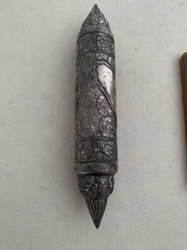
Submitted item photo
Submitted photo · June 4, 2026

User's notes

No additional notes provided.

AI analysis below

AI appraisal

AI analysis & estimate

AI-Generated · Verify before acting

Everything below is generated by AI for informational purposes only. AI can make mistakes — the AI may misidentify items or misattribute them (artist, maker, brand, designer, origin, era). This is not an official valuation and should not be used for insurance, sale, tax, estate, legal, or lending purposes — or any decision requiring a certified appraisal. It is not an authoritative claim about any person, brand, or rights holder — do not share or rely on it as a factual statement about a third party. Always consult qualified professionals before making financial decisions.

Read the full disclaimer

AI Identification

·Not independently authenticated·Verify before acting

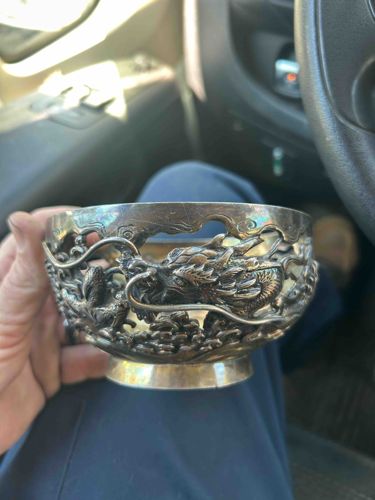
Chinese Export Silver Dragon Pierced Finger Bowl

Asian Antiques / Silver

AI Estimated Value

·Not an official valuation·Verify before acting

$1,800 - $2,500

As of June 4, 2026

AI Item Analysis

·AI can make mistakes·Verify before acting
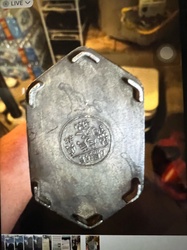
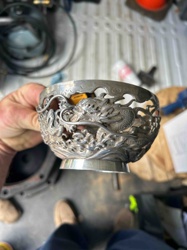
This is a highly ornate, double-walled Pierced Finger Bowl, likely made of Chinese Export Silver from the late 19th to early 20th century. The exterior wall features intricate open-work (pierced) repoussé and chased decoration depicting a massive Imperial-style dragon amidst swirling clouds and stylized waves. The dragon is rendered with significant Three-dimensional detail, particularly in the scales, whiskers, and facial features. The bowl consists of a solid interior liner to hold liquid, with the decorative openwork sleeve applied to the exterior. It sits on a flared, solid circular foot base. The material appears to be high-grade silver, showing a natural dark patina and tarnishing in the recessed areas which highlights the depth of the metalwork. The construction indicates high-quality craftsmanship, typical of the silver workshops in Shanghai, Hong Kong, or Canton (Guangzhou) during the Qing Dynasty or Early Republican period. The condition shows light surface wear and scratches consistent with age, but the delicate openwork remains largely intact without significant crushing or breaks in the thin silver bridges. No maker's mark is visible in the photograph, though such pieces are commonly stamped on the underside of the base with hallmarks or character marks like 'Luen Wo' or 'Wang Hing'.
AI Appraisal Report

·AI can make mistakes·Verify before acting
I have conducted a visual examination of this Chinese Export Silver (CES) double-walled finger bowl. The piece exhibits the hallmarks of high-quality craftsmanship from the late Qing Dynasty to the early Republican period (c. 1880–1920). The use of pierced openwork (linglong) combined with deep repoussé and chasing to create the high-relief Imperial dragon signifies a higher tier of production often associated with premier retailers like Wang Hing (Hong Kong) or Luen Wo (Shanghai). The structural integrity of the delicate cloud-bridge elements appears excellent with no visible 'crushing,' which often plagues these double-walled vessels. The market for CES remains robust, driven by mainland Chinese collectors repatriating heritage pieces. Comparables for dragon-motif openwork bowls of this caliber typically realize prices between $1,500 and $3,000 depending on weight and maker. The presence of the interior liner adds significant gram weight, which underpins the intrinsic value, while the 'dragon and pearl' iconography remains the most sought-after motif in the category. Limitations: This appraisal is based solely on digital imagery. While the patina and construction appear consistent with authentic period silver, I cannot definitively confirm the silver fineness (traditionally 90% or '900') without a touchstone or XRF test. A physical inspection is required to verify the presence of hallmarks on the base, which could increase the value by 20-30% if attributed to a known master silversmith. Furthermore, an in-person examination is necessary to check for 'invisible' silver solder repairs or small lead fills in the dragon’s head that may be obscured by the current patina. Provenance documentation would further solidify the valuation toward the higher end of the range.

Get your items appraised

Instant estimates of your treasures with AI-powered appraisals

Browse More Appraisals