These notes were written by the person who submitted this item. Appraiser.AI has not verified them, and the AI's identification and estimate may rely on them.
AI Estimated Value
Not an official valuation
$45-75
AI estimate as of November 10, 2025 · verify with a professional before acting
AI-Generated · Verify before acting
Everything on this page is generated by AI for informational purposes only. AI can make mistakes — the AI may misidentify items or misattribute them (artist, maker, brand, designer, origin, era). This is not an official valuation and should not be used for insurance, sale, tax, estate, legal, or lending purposes — or any decision requiring a certified appraisal. It is not an authoritative claim about any person, brand, or rights holder — do not share or rely on it as a factual statement about a third party. Always consult qualified professionals before making financial decisions.
This analysis also relies on unverified notes provided by the user, which may be incomplete or inaccurate and could affect the result.
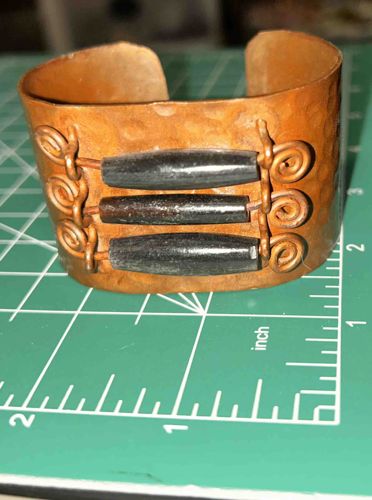
This is a handcrafted copper cuff bracelet, exhibiting a rustic and artisanal aesthetic. The bracelet is approximately 1.25 inches wide, as indicated by the measuring mat in the background. It features a hammered texture across its surface, giving it a somewhat uneven, organic appearance and an aged patina with variations in its coppery-brown tones. Three elongated, cylindrical black beads are horizontally integrated into the design on the front face of the cuff. These beads appear to be made of a dark, possibly polished stone or glass, and each measures approximately 1 inch in length. They are secured to the copper cuff by intricate copper wirework. On either side of the beads, the copper wire is coiled into S-shapes or spirals, forming decorative elements that also serve to hold the beads in place. The ends of the wire are neatly tucked or integrated into the main cuff structure. The edges of the cuff appear slightly irregular, consistent with a handmade item. The interior surface of the cuff cannot be fully seen but likely shares the same copper material and some degree of patination. There are no visible maker's marks, signatures, or stamps evident in the provided image. The style suggests a tribal, bohemian, or artisan-made piece, potentially dating from the mid to late 20th century or more modern, made to emulate an older style. The condition shows a natural verdigris and darkening typical of aged copper, enhancing its rustic charm rather than indicating damage. The craftsmanship appears to be good quality for a handmade item, with the wirework being even and securely attached. The item weighs 28 grams, which is a moderate weight for a cuff bracelet of this size.
AI Appraisal Report
Upon examining the provided images and details, I have assessed this handcrafted copper cuff bracelet. The piece presents a rustic, artisanal quality, characterized by a hammered texture, an aged patina, and decorative wirework securing three black beads. The weight is noted at 28 grams. The craftsmanship, featuring coiled wire details, appears competent for a handmade item, and the overall condition is good, with the patination contributing to its aesthetic rather than detracting from it. The style is consistent with contemporary artisan or bohemian jewelry from the late 20th century to the present. The primary value drivers are its material (copper) and its handmade, artistic appeal. The market for unsigned, non-precious metal artisan jewelry is broad, but values are modest. Comparable copper cuffs of similar size, weight, and craftsmanship typically sell in the $45 to $75 range on platforms like Etsy, art fairs, and secondary markets. The lack of a maker's mark or signature significantly limits its value, as it cannot be attributed to a known artist or workshop, which would otherwise increase its collectibility and price. Rarity is low, as this style of handcrafted jewelry is quite common. This appraisal is based solely on visual inspection of images. A full authentication would require physical examination to test the metal's purity and identify the material of the beads (e.g., stone, glass, or plastic). Without in-person inspection or provenance, it is impossible to definitively determine the piece's exact age, origin, or specific artist.