AI estimate as of October 8, 2025 · verify with a professional before acting
AI-Generated · Verify before acting
Everything on this page is generated by AI for informational purposes only. AI can make mistakes — the AI may misidentify items or misattribute them (artist, maker, brand, designer, origin, era). This is not an official valuation and should not be used for insurance, sale, tax, estate, legal, or lending purposes — or any decision requiring a certified appraisal. It is not an authoritative claim about any person, brand, or rights holder — do not share or rely on it as a factual statement about a third party. Always consult qualified professionals before making financial decisions.
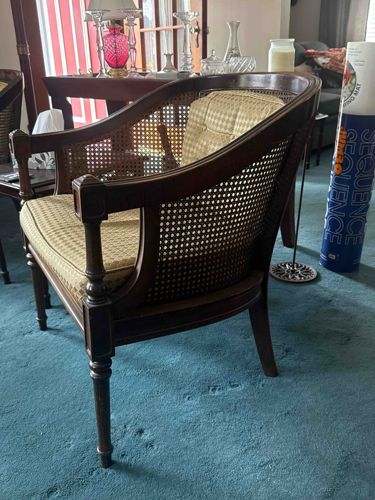
This is a vintage or antique barrel-style armchair, featuring a gracefully curved backrest and armrests that flow seamlessly into one another. The primary construction material appears to be a dark-stained hardwood, likely mahogany or a similar dense wood, exhibiting a rich, warm tone. The backrest and side panels of the chair are intricately caned, showcasing fine hand-woven cane webbing in a traditional pattern. This caning provides both structural integrity and a light, airy aesthetic. The chair is fitted with a removable, tufted seat cushion, upholstered in a light-colored fabric, possibly a cream or very pale yellow, with a subtle checkered or small-scale geometric pattern. The cushion appears well-padded, suggesting comfort. The armrests terminate in a squared-off front, featuring some carved details or turnings, particularly visible on the front legs. These front legs are turned, displaying decorative rings and tapers, ending in a slightly flared foot. The rear legs are simpler, tapering downwards for stability. The overall condition appears good, with a visible patina consistent with age and use, although no significant damage like cracks or breaks in the wood or caning are apparent from the image. The upholstery on the cushion seems clean, but its exact wear can't be fully assessed. This chair embodies a classic design, possibly dating from the late 19th to mid-20th century, drawing inspiration from Regency or Colonial revival styles. The craftsmanship, particularly the fine caning and turned legs, suggests a well-made piece of furniture.
AI Appraisal Report
Based on my visual examination of the provided image, I assess this Caned Barrel Armchair with Upholstered Cushion to be in very good vintage condition. The dark-stained hardwood, likely mahogany or a dense fruitwood, exhibits an attractive patina consistent with age and careful use. I observe no obvious structural damage such as cracks, splits, or significant repairs to the wood frame. The intricate caning appears intact with no visible breaks or sagging, which is a key factor in maintaining value for such pieces. The turned front legs with decorative rings and tapers, along with the gracefully curved barrel back, are hallmarks of quality craftsmanship, potentially dating from the early to mid-20th century, consistent with Regency or Colonial revival styles. The upholstered cushion, while clean from the image, cannot be fully assessed for wear, fading, or internal integrity without direct inspection.
Current market conditions show a steady demand for well-preserved vintage furniture, particularly pieces with classic designs and natural materials like cane. Comparables for similar caned barrel armchairs of this quality typically range from $400 to $800, depending on provenance, exact style, and condition. The fine caning and solid wood construction indicate a higher quality piece compared to mass-produced alternatives. Its classic aesthetic contributes to enduring demand. The primary factor impacting value positively is its overall excellent apparent condition and desirable style.
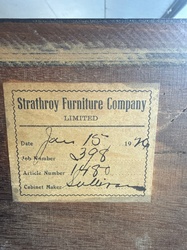
It is crucial to note the limitations of an image-only appraisal. While the visual indicators are strong, I cannot definitively verify the wood species, confirm the age with absolute certainty, or detect subtle repairs, woodworm, or internal cushion issues without a hands-on examination. A physical inspection would allow me to thoroughly check for loose joints, test the resiliency of the caning and cushion, and confirm the construction methods. Provenance documentation, if available, such as original purchase receipts or family history, would further solidify its authenticity and potentially enhance value.