AI estimate as of August 9, 2025 · verify with a professional before acting
AI-Generated · Verify before acting
Everything on this page is generated by AI for informational purposes only. AI can make mistakes — the AI may misidentify items or misattribute them (artist, maker, brand, designer, origin, era). This is not an official valuation and should not be used for insurance, sale, tax, estate, legal, or lending purposes — or any decision requiring a certified appraisal. It is not an authoritative claim about any person, brand, or rights holder — do not share or rely on it as a factual statement about a third party. Always consult qualified professionals before making financial decisions.
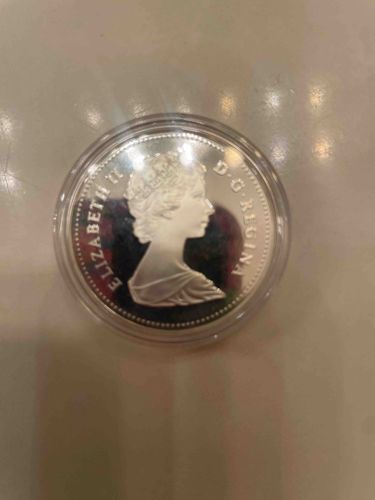
The item is a silver-colored coin, likely minted from a precious metal given its appearance, and is currently housed within a clear, circular plastic protective capsule. This capsule ensures the coin's preservation and protects its surface from environmental damage and handling. The obverse side of the coin, which is fully visible, features a right-facing effigy of Queen Elizabeth II. Her portrait is detailed, showing her wearing a crown. The engraving work appears to be of high quality, with clear lines and subtle dimensionality, suggesting a proof or at least a highly detailed strike. Around the effigy, along the rim of the coin, is a dotted border, adding to the refined aesthetic. Inscriptions are visible: 'ELIZABETH II' is written on the left side, following the curve of the coin, and 'D.G. REGINA' (Dei Gratia Regina, meaning 'By the Grace of God, Queen') is on the right side. The fields of the coin exhibit a mirror-like finish, characteristic of a proof coin, reflecting light and creating contrast with the frosted or matte finish of the effigy itself. There are no readily apparent condition issues such as scratches, tarnish, or damage visible through the protective casing, indicating it is likely in excellent, uncirculated condition. The craftsmanship suggests it is a product of a national mint, designed for commemorative or collector purposes rather than general circulation. Based on the inscription 'ELIZABETH II D.G. REGINA', this coin dates from her reign, specifically after her ascension in 1952. The style of the effigy suggests a mid to late 20th century minting.
AI Appraisal Report
Upon examining the provided image, I can confidently state that this coin featuring Queen Elizabeth II's effigy is in excellent, likely uncirculated condition, residing within a protective capsule. The mirror-like fields and frosted effigy indicate a proof strike, characteristic of high-quality commemorative or collector issues. The clear details, distinct lines, and overall presentation suggest authenticity as a product of a reputable national mint during Elizabeth II's reign, likely mid to late 20th century.
Market conditions for Queen Elizabeth II coinage, especially proof issues, remain consistently strong due to global collector interest and the historical significance of her long reign. While specific comparables would require knowing the mint, year, and metal composition, similar high-grade proof coins of Queen Elizabeth II typically command a healthy premium over their melt value (if precious metal). Demand is high among both numismatists and those seeking historically significant collectibles. Its rarity is currently indeterminate without knowing the mintage figures, but proof coins generally have lower mintages than circulated issues. The absence of visible flaws further enhances its desirability.
The primary factor impacting value is its superb condition and apparent proof status. However, a significant limitation of this appraisal is the lack of physical examination. While the image suggests authenticity, only an in-person inspection can definitively confirm the coin's metal content (silver-colored could be silver, platinum, or base metal), precise mintage year, and whether it exhibits any subtle damage not visible in the image. Provenance documentation (certificates of authenticity) and potential scientific testing (e.g., specific gravity for metal content) would be crucial for full, unequivocal authentication and to establish a precise value.