AI Appraisal Estimate

AI-generated estimates · not official valuations

From the user

What was submitted

Photo and notes provided by the user — not generated by AI

Submitted item photo
Submitted photo · May 17, 2026

User's notes

No additional notes provided.

AI analysis below

AI appraisal

AI analysis & estimate

AI-Generated · Verify before acting

Everything below is generated by AI for informational purposes only. AI can make mistakes — the AI may misidentify items or misattribute them (artist, maker, brand, designer, origin, era). This is not an official valuation and should not be used for insurance, sale, tax, estate, legal, or lending purposes — or any decision requiring a certified appraisal. It is not an authoritative claim about any person, brand, or rights holder — do not share or rely on it as a factual statement about a third party. Always consult qualified professionals before making financial decisions.

Read the full disclaimer

AI Identification

·Not independently authenticated·Verify before acting

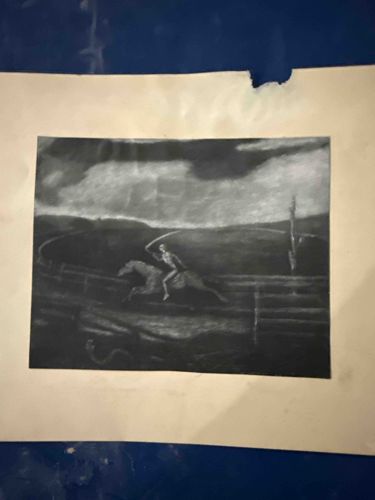
Reproduction Print of Albert Pinkham Ryder's "The Race Track (Death on a Pale Horse)"

Fine Art Prints

AI Estimated Value

·Not an official valuation·Verify before acting

$25 - $75

As of May 17, 2026

AI Item Analysis

·AI can make mistakes·Verify before acting
This item is a grayscale reproduction print of the famous oil painting 'The Race Track (Death on a Pale Horse)' by American artist Albert Pinkham Ryder, originally painted between 1895 and 1910. The image depicts a skeletal figure representing Death riding a horse along a curved racetrack, wielding a scythe under a dramatic, turbulent sky. In the foreground, a serpent can be seen. The print exhibits a high contrast, monochromatic palette of charcoal blacks, grays, and off-whites, mimicking the moody, Tonalist style of the original work. The artwork is mounted or printed on a larger cream-colored paper or cardstock backing. Regarding physical condition, the paper shows significant signs of age and wear; there is a large, jagged tear and loss of material at the top edge of the mounting paper, along with noticeable foxing, staining, and yellowing throughout the margins. The surface appears to have some undulation, suggesting exposure to moisture or poor storage conditions over time. There are no clearly visible artist signatures or edition numbers on the face of the print in this view. The print likely dates to the mid-20th century as a museum or educational reproduction.

AI Appraisal Report

·AI can make mistakes·Verify before acting
I have conducted a visual examination of this reproduction print of Albert Pinkham Ryder's 'The Race Track.' This item is a monochromatic photogravure or offset lithograph, likely produced for educational or museum gift shop distribution during the mid-20th century. It is not an original Ryder oil painting, nor is it a period-pull from an artist-authorized plate. My assessment of the physical condition reveals significant degradation: the mounting paper suffers from a major jagged tear at the top, extensive foxing (rust-colored spots), and acid-burn discoloration. The undulation of the substrate indicates historical exposure to high humidity, which has likely compromised the paper fibers. Market demand for damaged, mass-produced reproductions of Tonalist works is minimal, as collectors typically seek either original works or high-quality, pristine limited editions. The value is strictly decorative and significantly hampered by the lack of an artist signature, edition number, and the poor state of preservation. Limitations: This appraisal is based solely on digital imagery. A physical inspection would be required to determine the exact printing process (e.g., halftone vs. collotype) and to see if any hidden signatures exist under the mount. Full authentication of age would require microscopic analysis of the ink-to-paper relationship and UV fluorescence testing to check for hidden repairs. Provenance documentation, such as a gallery receipt or museum acquisition record, would be necessary to elevate this piece's historical context, though unlikely to significantly alter the valuation given the visible damage.

Get your items appraised

Instant estimates of your treasures with AI-powered appraisals

Browse More Appraisals