These notes were written by the person who submitted this item. Appraiser.AI has not verified them, and the AI's identification and estimate may rely on them.
AI Estimated Value
Not an official valuation
$125-$175
AI estimate as of August 17, 2025 · verify with a professional before acting
AI-Generated · Verify before acting
Everything on this page is generated by AI for informational purposes only. AI can make mistakes — the AI may misidentify items or misattribute them (artist, maker, brand, designer, origin, era). This is not an official valuation and should not be used for insurance, sale, tax, estate, legal, or lending purposes — or any decision requiring a certified appraisal. It is not an authoritative claim about any person, brand, or rights holder — do not share or rely on it as a factual statement about a third party. Always consult qualified professionals before making financial decisions.
This analysis also relies on unverified notes provided by the user, which may be incomplete or inaccurate and could affect the result.
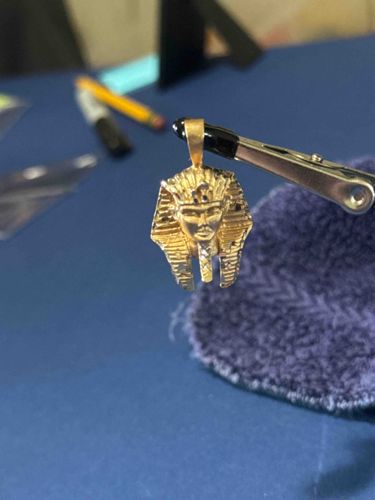
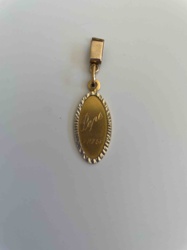
This item is a detailed pendant crafted from what the context indicates is 1.5 grams of 14k solid gold, depicting the iconic funerary mask of Tutankhamun. The pendant is small, designed to be worn on a necklace. Its overall color is a rich, warm yellow gold, characteristic of 14 karat gold, with a polished finish that reflects light. The craftsmanship is evident in the intricate details of the pharaoh's headdress, the nemes, showing the distinctive striped pattern in raised relief. The uraeus (cobras) and vulture head symbols, typically found on the forehead of the mask, appear to be integrated, although specific details are somewhat indistinct from the provided image due to the size. The facial features are subtly rendered, capturing the solemn expression of the original mask. There is a small, possibly diamond, accent set into the chin or beard area of the mask, adding a touch of sparkle. The bail, where a chain would pass through, is robust and designed proportionally to the pendant's size, suggesting durability. Visible condition appears very good, with no obvious signs of significant wear, scratches, or damage. The metal maintains its luster, indicating it has been well-preserved or recently cleaned. There are no discernible maker's marks or stamps visible in the provided image, although they would typically be located on the reverse side of the pendant or inside the bail. Given its design and material, this pendant would likely be contemporary, perhaps dating from the late 20th century to the present, inspired by ancient Egyptian revival styles. The quality of craftsmanship appears to be good for a mass-produced or semi-custom jewelry piece, with clear definition of the sculpted elements and a secure setting for the small accent stone.
AI Appraisal Report
Upon examining the provided image and information, I have assessed this Tutankhamun Mask Pendant. The item is described as being crafted from 1.5 grams of 14k solid gold. Visually, the pendant shows good craftsmanship with intricate details mimicking the famous funerary mask, including the nemes headdress and a small accent stone, possibly a diamond chip, on the beard. The condition appears to be very good, with a high polish and no visible signs of significant wear or damage.
The primary value driver for this piece is its gold content. As of my analysis, the melt value for 1.5 grams of 14k gold is approximately $55-$65, depending on the daily spot price. However, as a finished piece of jewelry, it carries a premium over its intrinsic metal value. The market for Egyptian revival jewelry is consistent, with Tutankhamun being a perennially popular motif. Similar new and pre-owned 14k gold pendants of this weight and quality typically retail for $125 to $225.
It is crucial to note the limitations of an appraisal based solely on images. While the piece appears to be 14k gold as stated, full authentication requires in-person examination. This would include testing the metal purity with an acid or electronic tester to confirm the '14k' fineness and identifying the small accent stone. Furthermore, locating a maker's mark or hallmark, usually on the reverse or bail, would help ascertain its origin and manufacturer, which could influence its value. Without physical inspection, the material composition cannot be definitively verified.