AI Appraisal Estimate

AI-generated estimates · not official valuations

From the user

What was submitted

Photo and notes provided by the user — not generated by AI

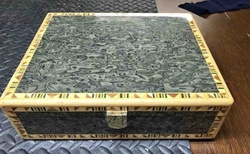
Submitted item photo
Submitted photo · June 22, 2026

User's notes

No additional notes provided.

AI analysis below

AI appraisal

AI analysis & estimate

AI-Generated · Verify before acting

Everything below is generated by AI for informational purposes only. AI can make mistakes — the AI may misidentify items or misattribute them (artist, maker, brand, designer, origin, era). This is not an official valuation and should not be used for insurance, sale, tax, estate, legal, or lending purposes — or any decision requiring a certified appraisal. It is not an authoritative claim about any person, brand, or rights holder — do not share or rely on it as a factual statement about a third party. Always consult qualified professionals before making financial decisions.

Read the full disclaimer

AI Identification

·Not independently authenticated·Verify before acting

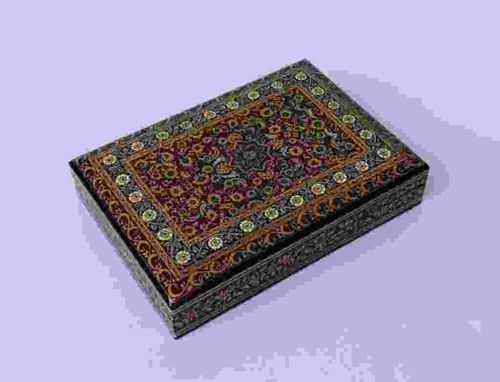
Persian Khatamkari and Hand-Painted Miniature Lacquer Box

Decorative Arts and Middle Eastern Antiques

AI Estimated Value

·Not an official valuation·Verify before acting

$450 - $650

As of June 22, 2026

AI Item Analysis

·AI can make mistakes·Verify before acting
This is a rectangular decorative box featuring intricate Persian craftsmanship, likely originating from Isfahan, Iran. The box is constructed using the Khatamkari technique—a form of marquetry made by bonding thin rods of wood, bone (often camel bone), and metal (brass) into geometric patterns, which are then sliced and applied to the wooden frame. The top lid showcases a central hand-painted miniature in the Safavid style, depicting a dense floral and bird 'Gol-o-Bolbol' motif on a rich burgundy-red ground. The composition is framed by multiple borders: an inner golden scroll, a secondary border featuring light green floral medallions, and an outer Khatam edge. The sides of the box are similarly decorated with repeating floral patterns against a dark, possibly black or deep blue ground, finished with a high-gloss lacquer that protects the delicate inlay and pigment. Based on the complexity of the pattern and the vibrancy of the colors, this piece likely dates to the late 20th century. The condition appears excellent with a well-maintained lacquer finish, no visible missing tesserae in the marquetry, and sharp corner joins, indicating high-quality hand-craftmanship. There are no obvious maker's marks visible in the image, common for such artisanal decorative arts.
AI Appraisal Report

·AI can make mistakes·Verify before acting
I have virtually examined this Persian Khatamkari and lacquer box. The piece exhibits the high level of intricacy associated with Isfahan workshops, characterized by the dense 'star' patterns of the marquetry and the classical 'Gol-o-Bolbol' miniature painting. Based on the craftsmanship, the use of brass filaments, and the specific pigment palette, I estimate this piece dates to the late 20th century (c. 1970–1990). The condition appears excellent; the lack of 'tenting' or lifting in the inlay suggests it has been kept in a stable climate, and the lacquer retains a high luster without the yellowing often seen in inferior specimens. The market for mid-to-late 20th-century Khatamkari remains steady, though it is currently a 'buyer's market' due to the volume of high-quality exports from Iran during this period. Comparables of similar size and complexity recently sold at specialized decorative arts auctions typically hammer between $400 and $700. The value is bolstered by the hand-painted miniature, which displays finer brushwork than the more common printed or stenciled alternatives. Note that this appraisal is based on photographic evidence. A definitive valuation would require an in-person inspection to verify the materials (identifying camel bone vs. plastic substitutes) and to check for structural warping of the underlying wood frame. To fully authenticate the piece and potentially increase its provenance value, I would recommend searching for a 'Khatam-Saz' signature often hidden within the micro-patterns or on the underside, and obtaining any original purchase receipts from reputable Iranian galleries. Scientific testing (UV light) could further confirm if the lacquer is traditional shellac or a modern synthetic resin.

Get your items appraised

Instant estimates of your treasures with AI-powered appraisals

Browse More Appraisals