AI estimate as of August 6, 2025 · verify with a professional before acting
AI-Generated · Verify before acting
Everything on this page is generated by AI for informational purposes only. AI can make mistakes — the AI may misidentify items or misattribute them (artist, maker, brand, designer, origin, era). This is not an official valuation and should not be used for insurance, sale, tax, estate, legal, or lending purposes — or any decision requiring a certified appraisal. It is not an authoritative claim about any person, brand, or rights holder — do not share or rely on it as a factual statement about a third party. Always consult qualified professionals before making financial decisions.
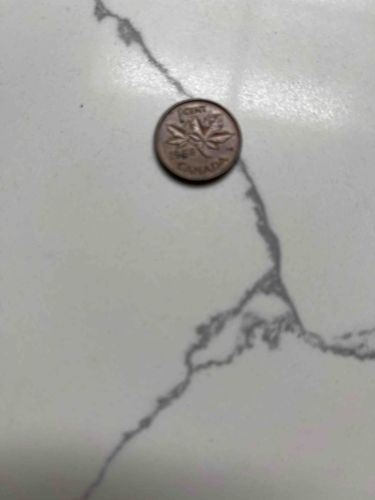
The item is a Canadian one-cent coin, commonly known as a penny, from the year 1969. The coin appears to be made of bronze or copper, giving it a reddish-brown color, characteristic of Canadian pennies from that era. Its circular shape is standard for coinage. The obverse side (not visible in the image but typically featuring the monarch's effigy) is not shown. The reverse side, which is visible, prominently displays a single maple leaf, a national symbol of Canada, centrally located on the coin. Above the maple leaf, the denomination "CENT" is clearly inscribed. Below the maple leaf, the year "1969" is visible, with the country name "CANADA" curved along the bottom edge of the coin. The details of the maple leaf and the lettering appear relatively crisp, suggesting good strike quality. The coin exhibits a visible patina consistent with its age and material, with some darker areas indicating oxidation. There are no obvious signs of severe damage such as deep scratches, significant dents, or corrosion, although the resolution of the image makes it difficult to ascertain minute surface imperfections. The rim appears intact. This coin would have been part of the regular circulation coinage of Canada during the late 1960s. Its overall condition seems to be in the circulated range, likely Fine to Very Fine, retaining most of its original design elements without excessive wear.
AI Appraisal Report
Upon examining the provided image of the 1969 Canadian One-Cent coin, I assess its condition to be in the Fine to Very Fine (VF) range. The details of the maple leaf and lettering, particularly 'CENT', '1969', and 'CANADA', are clearly legible with good definition, indicating moderate circulation wear rather than heavy abrasion. The coin exhibits a consistent reddish-brown patina, typical of bronze/copper coinage of this era, with some darker areas suggesting normal oxidation processes rather than significant environmental damage. The rim appears intact, and I detect no obvious signs of significant defects such as deep scratches, major dents, or corrosion. Authenticity, based solely on visual characteristics from the image, appears to be consistent with known genuine 1969 Canadian pennies; the design elements, date, and general appearance align with official mintages. However, definitive authentication would require in-person examination to verify weight, diameter, thickness, metallic composition, and to carefully inspect for any tooling marks or inconsistencies that might indicate a counterfeit.
From a market perspective, 1969 Canadian pennies are common circulation coins. Millions were minted, and they are readily available in various conditions. There are no known significant varieties or key-dates for the 1969 mintage that would dramatically increase its value. As such, demand for typical circulated examples is low to moderate, mainly driven by beginner collectors filling albums or individuals seeking specific dates for souvenir purposes. Comparables from online marketplaces and dealer inventories show similar circulated examples typically trading for very minimal amounts.
Factors significantly impacting value for common coins like this are primarily tied to exceptionally high grades (Uncirculated or Proof), specific mint errors (which are not apparent here), or unique provenance. This particular coin, being a common date in a circulated condition, does not present any of these value-enhancing factors.
Limitations of this appraisal include the inability to physically inspect the coin, which means I cannot verify its exact weight, metallic composition, or detect subtle surface imperfections, hairline scratches, or environmental damage that might be obscured by the image resolution. Critical aspects for full authentication, such as edge characteristics, die varieties, and any potential alterations, cannot be definitively confirmed without a direct, hands-on examination, potentially under magnification, and comparison with known genuine examples or through non-destructive scientific testing.