These notes were written by the person who submitted this item. Appraiser.AI has not verified them, and the AI's identification and estimate may rely on them.
AI Estimated Value
Not an official valuation
$25-$50
AI estimate as of August 17, 2025 · verify with a professional before acting
AI-Generated · Verify before acting
Everything on this page is generated by AI for informational purposes only. AI can make mistakes — the AI may misidentify items or misattribute them (artist, maker, brand, designer, origin, era). This is not an official valuation and should not be used for insurance, sale, tax, estate, legal, or lending purposes — or any decision requiring a certified appraisal. It is not an authoritative claim about any person, brand, or rights holder — do not share or rely on it as a factual statement about a third party. Always consult qualified professionals before making financial decisions.
This analysis also relies on unverified notes provided by the user, which may be incomplete or inaccurate and could affect the result.
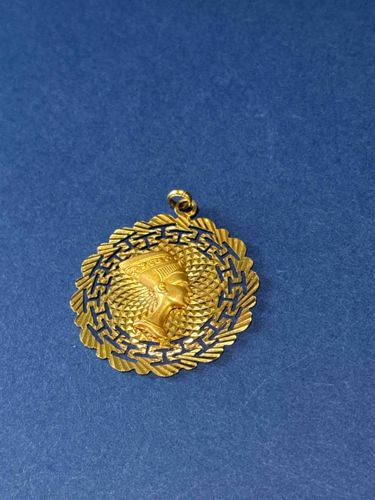
This is a circular gold tone pendant, approximately 1.5 inches in diameter, featuring a central raised effigy of Nefertiti, an ancient Egyptian queen. The Nefertiti bust is rendered in a smooth, polished gold finish, contrasting with the textured background within the central medallion. The background behind the bust appears to have a finely ridged or braided texture, radiating outwards from the center. Surrounding this central medallion, there is an intricately cut-out outer border. This border is composed of repeating abstract, possibly stylized geometric motifs or hieroglyphics, creating a visually interesting relief pattern. The overall construction suggests a combination of cast and possibly stamped or laser-cut elements. The pendant has a scalloped or wavy edge along its outermost perimeter, adding to its decorative appeal. A small, circular bail is affixed at the top of the pendant, allowing it to be worn on a chain. The gold color appears consistent across the piece, suggesting it is either solid gold or gold-plated metal, with a bright, reflective quality indicating good preservation. There are no obvious signs of significant wear, damage, or repairs visible in the image, and the patina is consistent with a well-maintained piece. The craftsmanship, particularly the detailed relief of the Nefertiti bust and the precise cut-outs of the border, points to a moderate to good quality item. Given the classical Egyptian motif, this piece likely dates from the 20th or 21st century, drawing inspiration from ancient Egyptian art and history, a common theme in jewelry design.
AI Appraisal Report
Upon examining the provided image and description of this Gold Nefertiti Pendant, my assessment is as follows. The piece is a 1.5-inch diameter pendant featuring a central bust of Queen Nefertiti, surrounded by a detailed, repeating border. The design elements are consistent with jewelry produced during the 20th and 21st centuries, inspired by the Egyptian Revival trend. The craftsmanship appears to be of good quality, with clean lines in both the central effigy and the cut-out border. The item is described as 'gold tone,' which is the most critical factor influencing its value. This term typically indicates that the item is gold-plated or made from a base metal alloy, rather than solid karat gold. Without in-person testing, I must proceed with this assumption.
Market analysis of similar vintage or contemporary Nefertiti pendants made from non-precious, gold-plated metals shows a value primarily driven by decorative appeal rather than intrinsic material worth. These pieces are quite common and serve a wide costume jewelry market. The ankh and eye of horus motifs are quite common but this filigree style is a little rarer, however being gold toned and not solid gold, value is limited. My valuation assumes the pendant is not made of solid gold and contains no precious gemstones.
A definitive appraisal would require physical examination to determine the metal's composition via acid testing or an XRF spectrometer, as well as to check for any maker's marks or hallmarks not visible in the image. If testing were to reveal it is solid 14k or 18k gold, its value would increase substantially based on the current gold spot price and the item's weight.