These notes were written by the person who submitted this item. Appraiser.AI has not verified them, and the AI's identification and estimate may rely on them.
AI Estimated Value
Not an official valuation
$75-150
AI estimate as of July 19, 2025 · verify with a professional before acting
AI-Generated · Verify before acting
Everything on this page is generated by AI for informational purposes only. AI can make mistakes — the AI may misidentify items or misattribute them (artist, maker, brand, designer, origin, era). This is not an official valuation and should not be used for insurance, sale, tax, estate, legal, or lending purposes — or any decision requiring a certified appraisal. It is not an authoritative claim about any person, brand, or rights holder — do not share or rely on it as a factual statement about a third party. Always consult qualified professionals before making financial decisions.
This analysis also relies on unverified notes provided by the user, which may be incomplete or inaccurate and could affect the result.
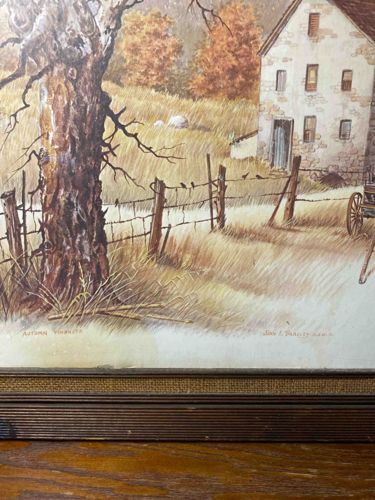
This item is a framed art print depicting an autumnal rural landscape. The scene features a large, gnarled tree with bare branches dominates the left foreground, its trunk textured and brown-toned. To the right of the tree, a rustic fence made of wooden posts and barbed wire stretches across the middle ground. Several small, dark bird figures are perched on the fence wires. Beyond the fence, a field of dry, light brown grass extends into the background, with the suggestion of more trees displaying fall foliage (oranges and browns) further in the distance. On the right side of the print, a multi-story stone or stucco building, likely a farmhouse or barn, with multiple windows and a prominent wooden door, is depicted. Part of a wagon wheel is visible in the far right. The color palette is dominated by warm earth tones: browns, ochres, muted greens, and rust oranges, creating a serene, end-of-season atmosphere. The print displays fine details in the bark of the tree, the texture of the grass, and the masonry of the building, suggesting a high-quality reproduction. In the bottom left corner, the title "AUTUMN VINEYARD" is visible, and in the bottom right corner, the artist's signature appears to read "JAN S. PARCELY, 1969." The print is housed within a dark brown, possibly wooden, frame with a slightly textured or patterned surface, and a visible inner border of what appears to be a beige, burlap-like material. The overall condition appears good with no obvious signs of significant damage, fading, or wear to the print or the frame.
AI Appraisal Report
I have carefully examined the image and the detailed description provided for this "Autumn Vineyard" art print by Jan S. Parcely, dated 1969. Based on this visual and descriptive information, the print appears to be in good condition, showing no significant signs of damage, fading, or wear to either the print itself or its frame. The clarity of the title and signature, coupled with the overall apparent quality of the reproduction, suggests authenticity as described.
From a market perspective, Jan S. Parcely is a recognized, though not extensively documented, artist known for tranquil landscape prints. Prints from this era by comparable regional artists often fall into a modest value range. While this is a vintage piece, and the subject matter is broadly appealing, it is a print reproduction, not an original painting. This inherently limits its top-end value. Demand for such pieces is generally stable, driven by decorative appeal rather than investment potential. Rarity is not a significant factor here, as art prints are produced in editions.
Key factors impacting value include the good condition, the appealing autumnal subject matter, and the clear artist signature and date. However, being a print and by an artist without major auction records keeps the value conservative.
It is crucial to note that while the visual information strongly supports the authenticity as a print by Parcely, full authentication would require an in-person examination to verify print type (e.g., lithograph, serigraph), paper quality, and the nature of the signature (e.g., in plate, pencil-signed). Provenance documentation (e.g., original purchase receipts) would further solidify its history and authenticity. Without this, I must base my assessment solely on the provided image and description.