These notes were written by the person who submitted this item. Appraiser.AI has not verified them, and the AI's identification and estimate may rely on them.
AI Estimated Value
Not an official valuation
$30-60
AI estimate as of December 7, 2025 · verify with a professional before acting
AI-Generated · Verify before acting
Everything on this page is generated by AI for informational purposes only. AI can make mistakes — the AI may misidentify items or misattribute them (artist, maker, brand, designer, origin, era). This is not an official valuation and should not be used for insurance, sale, tax, estate, legal, or lending purposes — or any decision requiring a certified appraisal. It is not an authoritative claim about any person, brand, or rights holder — do not share or rely on it as a factual statement about a third party. Always consult qualified professionals before making financial decisions.
This analysis also relies on unverified notes provided by the user, which may be incomplete or inaccurate and could affect the result.
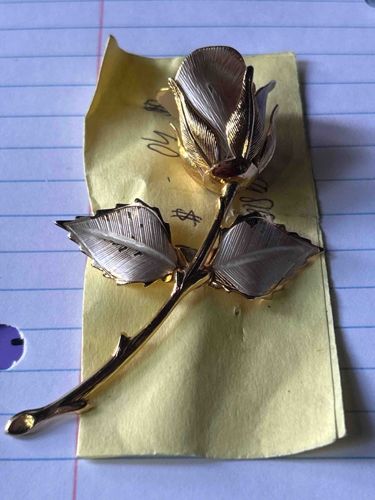
This item is a decorative brooch or pin designed in the likeness of a rose bud with accompanying leaves and stem. The piece exhibits a two-tone metallic finish; the rose bud itself and the stem appear to be a bright, polished gold-tone, while the two prominent leaves are a contrasting matte silver-tone. The rose bud is intricately detailed, showing individual petals with fine striations or textured lines suggesting natural veining and depth. The leaves also feature similar fine linear texturing, mimicking leaf veins, which adds to the naturalistic representation. The stem, in gold-tone, is slender and includes a subtle, realistic thorn-like protrusion, further enhancing the botanical accuracy. The overall construction suggests it is made from metal, likely a base metal with gold and silver plating or rhodium finish for the two-tone effect. The reverse side, where the pin mechanism would be located, is not visible in the provided image. The condition appears good from the visible side, with no obvious signs of significant wear, tarnish, or damage. The bright reflective quality of the gold-tone elements suggests a relatively well-preserved finish. This style of pin was popular in the mid-20th century, particularly within the 1950s-1970s, though similar designs continue to be produced. The craftsmanship, particularly the detailed texturing on the petals and leaves, indicates a piece designed with an eye for naturalistic beauty, likely machine-stamped and then assembled, possibly with some hand-finishing.
AI Appraisal Report
I have carefully examined the provided image of this Two-Tone Rose Bud Brooch Pin. Visually, the piece appears to be in very good condition, with the gold-tone plating on the rose bud and stem, and the silver-tone on the leaves, showing good luster and no obvious signs of significant wear, tarnish, or damage. The intricate detailing on the petals and leaves, including the subtle textures and the thorn-like protrusion on the stem, suggests a design focused on naturalistic representation. This level of detail is consistent with good quality costume jewelry from the mid-20th century. Authenticity as a piece of costume jewelry from this era, specifically the 1950s-1970s, seems plausible based on style and construction. Given that it is likely a base metal with plating, its intrinsic material value is negligible.
Market conditions for vintage costume jewelry of this type are fairly stable. While desirable for collectors of specific styles, the demand for unbranded, plated rose pins remains moderate. Similar pieces are readily available across various online marketplaces and antique shops. Rarity is not a significant factor here; while well-preserved, this design is not unique or attributed to a highly sought-after designer.
The primary factors impacting value are its good condition, charming design, and perceived quality for a costume piece. Without examining the reverse side, I cannot confirm the pin mechanism's integrity, nor can I definitively determine the specific base metals or plating thickness. A physical examination would allow for tactile inspection of craftsmanship, confirmation of materials (e.g., distinguishing between plating and solid gold/silver, if applicable, though highly unlikely for this piece's visual characteristics), and assessment of any potential maker's marks, which would be crucial for precise attribution and could significantly impact value if a renowned designer is identified. Currently, based on visual evidence alone, I assess this as a well-maintained piece of vintage costume jewelry.