AI estimate as of September 28, 2025 · verify with a professional before acting
AI-Generated · Verify before acting
Everything on this page is generated by AI for informational purposes only. AI can make mistakes — the AI may misidentify items or misattribute them (artist, maker, brand, designer, origin, era). This is not an official valuation and should not be used for insurance, sale, tax, estate, legal, or lending purposes — or any decision requiring a certified appraisal. It is not an authoritative claim about any person, brand, or rights holder — do not share or rely on it as a factual statement about a third party. Always consult qualified professionals before making financial decisions.
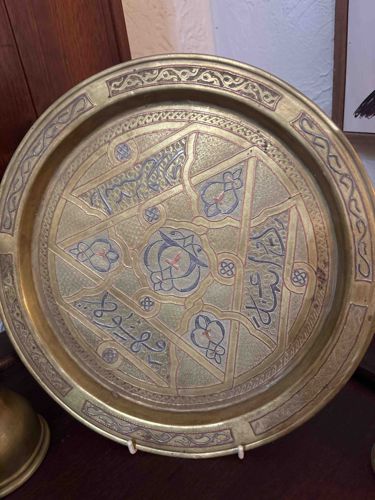
This is a circular, shallow tray, likely constructed from brass or a brass alloy, given its golden-yellow metallic sheen. The surface of the tray is richly decorated with an intricate design featuring both Islamic calligraphy and geometric patterns. The primary color scheme consists of the natural brass tone for the raised or un-inlaid areas, contrasted with darker, possibly silver-colored or darkened copper inlay, and touches of reddish-orange, perhaps a pigment or different metal inlay, within the central floral-like motifs. The design in the central field appears to be organized around a large, multifaceted star or polygonal shape, within which various calligraphic inscriptions are present. Surrounding these inscriptions are stylized floral elements and interweaving knot or strapwork patterns. The outer rim of the tray features a continuous band of scrolling arabesque or vine-like patterns, demonstrating consistent craftsmanship. The inlay technique appears to be damascening or similar metal inlay, where contrasting metals are hammered into an incised surface. The overall condition shows a visible patina consistent with age and handling, including some darkening and possible minor tarnishing of the brass, particularly in recessed areas and along the rim. There are no obvious signs of significant damage such as large dents, cracks, or repairs visible in the provided image, though detailed inspection would be required to confirm. The craftsmanship suggests a hand-worked piece, with the precision of the inlay indicating a skilled artisan. This style is characteristic of Middle Eastern or North African metalware, possibly from the late 19th to early 20th century.
AI Appraisal Report
I've examined the provided image of this inlaid brass or copper tray. Based on the visual evidence, it presents as a well-crafted piece of Decorative Metalware, likely from the Middle East or North Africa, consistent with late 19th to early 20th-century production. The intricate geometric and calligraphic motifs, executed with what appears to be damascene or similar metal inlay, speak to a skilled artisan. The inlay shows good precision and detail, suggesting quality workmanship.
Condition-wise, the visible patina, including darkening and some tarnishing, is consistent with age and typical handling, indicating it has not been over-cleaned. I see no obvious signs of significant damage like large dents, cracks, or repairs from the image, which is positive. However, minor surface scratches or subtle anomalies in the inlay would require close physical inspection to confirm.
In terms of market conditions, similar inlaid trays with Islamic calligraphy and geometric patterns tend to have a steady demand among collectors of Islamic art, decorative arts, and Middle Eastern antiques. Objects of this quality, especially those with clear craftsmanship and good condition, are desirable. Comparables from reputable auction houses and dealer websites suggest values in the mid-hundreds to low thousands depending heavily on the provenance, size, metal composition verification, and the specific artist or workshop if identifiable. Rarity isn't exceptionally high for this general type of item, but the quality of this particular piece elevates its desirability.
Factors positively impacting value include the intricate detail, apparent good condition for its age, and the aesthetic appeal of the combined calligraphy and geometric motifs. Limitations in authenticity verification from images alone are significant. While the style and apparent technique are appropriate, a physical examination is crucial to confirm the precise metal composition (brass vs. copper, and the inlay materials), verify the inlay method's integrity (i.e., not painted on), assess the true extent of any wear or damage, and confirm the object's age through tactile and material analysis. Provenance documentation, if available, would significantly enhance authentication and value, as would scientific metallurgical testing to confirm original materials and construction.