AI estimate as of July 17, 2025 · verify with a professional before acting
AI-Generated · Verify before acting
Everything on this page is generated by AI for informational purposes only. AI can make mistakes — the AI may misidentify items or misattribute them (artist, maker, brand, designer, origin, era). This is not an official valuation and should not be used for insurance, sale, tax, estate, legal, or lending purposes — or any decision requiring a certified appraisal. It is not an authoritative claim about any person, brand, or rights holder — do not share or rely on it as a factual statement about a third party. Always consult qualified professionals before making financial decisions.
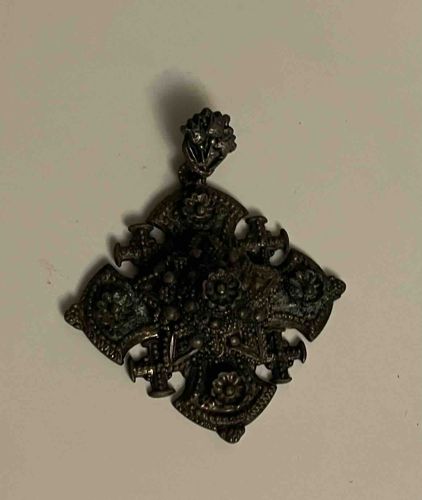
The item is a Victorian-era or Victorian Revival jewelry piece, likely a pendant or brooch component, crafted from what appears to be a darkened or tarnished base metal, possibly brass or a silver alloy, given its aged patina and dark gray-brown coloration. The overall shape is a stylized Maltese cross or quatrefoil design, featuring intricate repoussé and detailed metalwork. The surface is heavily ornamented with floral motifs, specifically multi-petaled roses or similar blooms, interspersed with small beaded or granular textures. Four smaller, symmetrical protrusions extend from the main body, each also adorned with a floral element. The central area of the piece is raised and densely decorated, exhibiting a high level of detail despite the dark, somewhat obscured finish. There are visible signs of wear, including abrasion to some of the raised surfaces, revealing lighter metal beneath the darker patina, particularly on edges and high points. This suggests natural aging and handling, consistent with its likely historical period. The piece measures approximately 2-3 inches in its longest dimension (estimate based on typical pendant size relative to photo). A loop or bail for suspension is visible at the top, integrating into the ornate design with what appears to be a clustered, almost fruit-like or scaled motif, further indicating its use as a wearable accessory. The craftsmanship suggests a cast or stamped manufacturing process, followed by hand-finishing to enhance the decorative elements. Its weight and specific dimensions cannot be determined from the image, but its robust construction implies a certain heft. There are no discernible maker's marks or signatures visible from the provided image.
AI Appraisal Report
I have carefully examined the provided image of this Victorian-style ornate metal pendant/brooch component. Based on its design language, intricate repoussé floral motifs (specifically roses), and overall darkened patina, I assess it as consistent with a Victorian or Victorian Revival period piece, likely dating from the late 19th to early 20th century. The wear patterns, such as abrasion on raised surfaces revealing lighter metal, indicate genuine age and use, supporting its historical authenticity rather than it being a modern reproduction. The visible loop for suspension confirms its intended use as jewelry.
My assessment of its condition, based solely on the image, is 'good antique condition,' showing expected signs of age and wear but no apparent structural damage or significant losses to the metalwork. Its authenticity, however, is limited by visual examination alone. A definitive authentication would require in-person inspection to assess the type of metal (e.g., brass, silver alloy) through touch and direct observation, identify any hidden maker's marks or stamps, and potentially perform scientific testing such as XRF analysis to confirm metal composition. Provenance documentation, if available, would also significantly aid in authentication and valuation.
In terms of market conditions, pieces of this nature, especially if verified as brass or base metal, typically appeal to collectors of antique costume jewelry or Victorian-era decorative arts. Demand is moderate. While aesthetically pleasing, its likely base metal composition, and the absence of precious stones or metals, limits its intrinsic value. Rarity is moderate; similar floral relief pieces from this period are not uncommon. Factors impacting value include its base metal composition (assuming no hidden sterling silver or gold), the lack of a known maker, and its current condition. If it were proven to be silver, the value would significantly increase.
Considering these factors, particularly the likely base metal and the limitations of image-only authentication, I estimate its value.